

AI Freelancing in 2026: The Best Beginner’s Guide to Making Money Online
Something shifted in the freelance economy this past year, and the numbers back it up. Searches for AI agent freelancers on Fiverr jumped more than 18,000% in a single six-month stretch of 2025, and Upwork’s own research shows freelance skills tied directly to AI grew 109% year over year — based on completed contracts, not surveys or wishful job-posting counts. That’s real money changing hands for real work.
If you’ve been wondering whether AI freelancing is still worth getting into in 2026, or whether the window already closed, this guide answers that with data instead of hype. We’ll walk through exactly which AI services are selling right now, what they’re actually going for, which platform fits your situation, and the specific steps to land your first paying client — whether that’s on Fiverr, Upwork, a newer commission-free platform, or through outreach you run yourself.
This is written for two kinds of readers: complete beginners who’ve never freelanced before, and existing freelancers looking to fold AI-powered services into what they already offer. Either way, you’ll walk away with a realistic, platform-specific game plan instead of the vague “just start freelancing with AI” advice that floods most of the internet.
What Is AI Freelancing in 2026? (And How It’s Different Now)

AI freelancing means offering freelance services where AI tools handle a meaningful part of the production work — writing, design, video editing, chatbot building, automation — while you provide the direction, the quality control, and the actual client relationship.
Here’s what’s changed since AI freelancing first became a buzzword: knowing how to write a decent ChatGPT prompt is no longer a sellable skill on its own. Clients now expect freelancers to build real systems and show measurable outcomes, not just hand over generic AI output and call it a day. The freelancers charging premium rates aren’t the ones typing clever prompts. They’re the ones building reliable AI-powered systems that save clients time or make them money — and can prove it.
Quick Summary: In 2024, “AI freelancer” mostly meant someone who used ChatGPT. In 2026, it means someone who builds working AI systems — chatbots that pull real business data, automations that route and respond to customer emails, video pipelines that turn raw AI footage into polished content — and who can point to results, not just output.
This shift matters because it changes what beginners should actually spend time learning. Prompt writing is now table stakes, not a differentiator. The real opportunity sits in pairing an AI tool with a specific skill you already have — writing, design, customer service systems, marketing — and packaging that combination as a service someone will pay for.
If freelancing turns out not to be your preferred path, our guide to AI affiliate marketing in 2026 covers a more passive route to AI-related income that doesn’t require managing client relationships at all.
Why AI Freelancing Is Exploding Right Now
A handful of forces are driving this growth at the same time, and understanding them helps explain where the real opportunities actually sit — as opposed to where the noise is loudest.
Businesses Know They Need AI, But Don’t Know How to Implement It
Despite the constant AI headlines, most companies still lack the in-house expertise to deploy these tools well. That gap between AI ambition and technical reality is driving a surge in demand for freelancers who can bridge it. This is exactly where beginner and intermediate freelancers can step in — you don’t need to be an AI researcher, you just need to be more capable than the average small business owner trying to figure this out alone at 11pm.
AI-Enabled Freelancers Are Earning Meaningfully More
The income data here is hard to argue with. AI-enabled freelancers earn roughly 40% more per hour than freelancers relying on traditional methods alone. Part of that comes down to raw efficiency: deliverables that used to take six hours now take closer to two and a half, while rates stay the same — which nearly triples effective hourly profit for freelancers who’ve built AI into their workflow.
Demand Isn’t Limited to “AI Jobs” — It’s Reshaping Existing Categories
One of the more useful findings in Upwork’s 2026 research is that demand for foundational human skills — full-stack development, general virtual assistance, data analytics, graphic design — has stayed consistently strong year over year, even as AI-specific skills surge. AI isn’t creating an entirely separate job category so much as it’s getting woven into every existing freelance category at once.
Specific Sub-Niches Are Growing Explosively
The growth isn’t spread evenly, and that’s worth paying attention to. On Upwork, AI video generation and editing grew 329% year over year, AI integration work grew 178%, and AI image generation and editing grew 95%. On Fiverr, interest in automation tools like n8n rose 125%, searches tied to Claude’s coding capabilities surged 938%, and “vibe coding” interest climbed 61%. AI voice agents grew 49%, AI mobile app development grew 92%, and AI website development grew 39% in business search interest over the same period.
Freelancing Overall Is Becoming More Mainstream
None of this is happening in isolation. Roughly 38% of skilled knowledge workers now operate as freelancers or independent professionals, and freelancers consistently report more optimism about where their careers are headed than traditionally employed workers do.
Pro Tip: Don’t chase the label “AI freelancer” — chase the specific, growing sub-niche within a category you already understand. A copywriter who adds AI-editing services will usually find steadier work than someone with no writing background trying to compete purely as a generic “AI prompt expert.”
The Best AI Freelance Services to Offer in 2026 (With Real Pricing)
Here’s what’s actually selling right now, based on current market data rather than guesswork.
| Service | Difficulty | Typical Pricing | Best AI Tools |
|---|---|---|---|
| AI Chatbot & Virtual Agent Development | Intermediate | $50–$1,000 per project | Voiceflow, Claude/ChatGPT via API, Tidio |
| AI Automation & Agent Workflows | Intermediate | $100–$1,500 per project | Zapier, Make.com, n8n |
| AI-Assisted Content Writing | Beginner | $20–$1,000 per project | Claude, ChatGPT, Grammarly, Surfer SEO |
| AI Video Editing & Generation | Intermediate–Advanced | Varies by scope | Runway, CapCut, Descript |
| AI Voice Cloning & Voiceover | Beginner–Intermediate | Varies by scope | ElevenLabs, Murf |
| AI-Powered Copy Editing | Beginner | Varies by scope | Claude, ChatGPT, Grammarly |
| AI-Powered Virtual Assistance | Beginner | Hourly or retainer | Claude, ChatGPT, Zapier |
For a deeper breakdown of which tools are worth paying for versus which free tiers are good enough, our guide to the best AI tools for beginners in 2026 covers the full comparison.
1. AI Chatbot & Virtual Agent Development

What it is: Building a chatbot trained on a business’s actual data — product docs, FAQs, policies — that can answer customer questions, qualify leads, or take actions like booking appointments.
What changed: Early chatbots were essentially ChatGPT with a basic instruction prompt bolted on. The 2026 generation uses retrieval-augmented generation (RAG) and tool integration, so the bot pulls real business information and completes actual tasks instead of just answering generic questions.
Realistic pricing:
| Tier | What’s Included | Price Range |
|---|---|---|
| Basic | ChatGPT/Claude wrapper with custom prompts and FAQ data loaded in | $50–$200 |
| Advanced | RAG-based chatbot trained on real documents, handles nuanced questions, website widget integration | $200–$1,000 |
Skills needed: Basic understanding of chatbot platforms, and a willingness to learn RAG concepts. You don’t need to be a developer — most no-code tools now handle the heavy lifting for you.
Beginner Tip: Start with the Basic tier for your first two or three clients, even if you’re capable of more. It’s an easier sell, it builds your testimonial base faster, and it gives you room to learn the RAG-based approach before you’re troubleshooting it live for a paying client.
2. AI Automation & Agent Workflows

What it is: Building automated business processes on no-code platforms with AI steps baked in — reading an email, understanding intent, drafting a reply, updating a CRM, and notifying the right person, all without manual work.
Realistic pricing:
| Tier | What’s Included | Price Range |
|---|---|---|
| Single workflow | One automation (e.g., support email triage and response) | $100–$500 |
| Multi-workflow system | 3–5 connected automations covering an entire business process | $500–$1,500 |
One Fiverr-based AI consultant reported that automation, voice, and integration requests now make up roughly half of his active project pipeline — a sharp shift from the simple chatbot requests that dominated just a year or two earlier. That kind of shift tells you where client expectations are heading: fewer one-off gigs, more ongoing systems.
3. AI-Assisted Content Writing (Done Right)

What it is: Writing blog posts, articles, and web copy using AI for research and first drafts, with genuine human editing, expertise, and original insight layered on top.
What separates this from AI slop: Raw, unedited AI output flooded the internet in 2024 and 2025, and it largely stopped ranking. What sells now is content where AI accelerates the research and drafting stage, while a human adds original perspective, data-backed claims, and proper structure. Google’s Helpful Content guidance has only reinforced this — content that reads as genuinely useful and experience-based outperforms generic AI text, and clients who follow SEO trends know it.
Realistic pricing:
| Tier | What’s Included | Price Range |
|---|---|---|
| Budget | AI-assisted blog posts with human editing, 1,000–2,000 words | $20–$75 per article |
| Premium | AI-assisted research, human-written with real expertise and original angles, 1,500–3,000 words | $75–$300 per article |
| Full strategy | Keyword research, content calendar, topic clusters, plus 5–10 articles | $300–$1,000 per project |
4. AI Video Editing & Generation
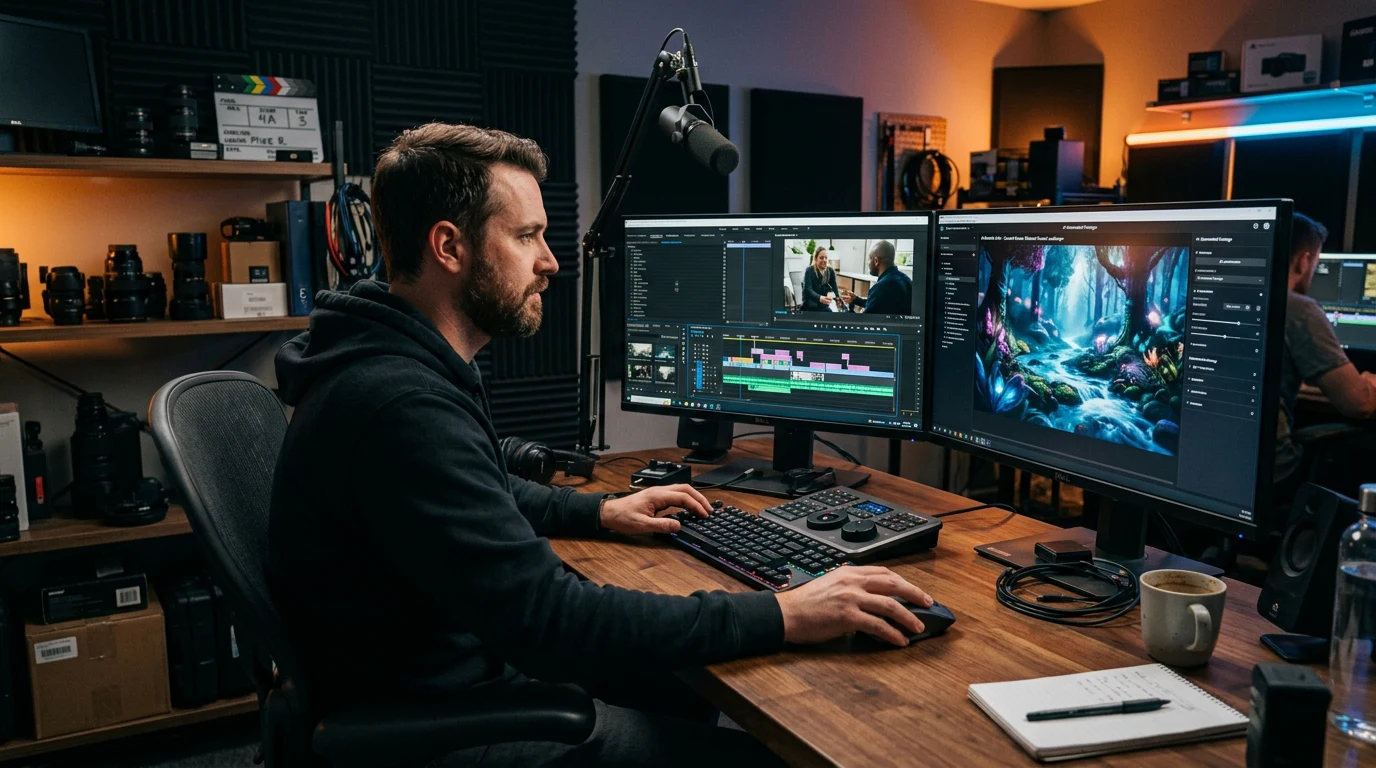
What it is: Turning raw AI-generated video (from tools like Runway, Sora, or Kling) into polished, usable content, or producing AI-generated product videos at a fraction of traditional production costs.
This is currently the single fastest-growing AI skill category on Upwork by a wide margin, driven largely by clients who can generate raw AI footage themselves but need someone to shape it into something usable for marketing or social media. If you already have a video editing background, this is arguably the easiest AI pivot on this entire list.
5. AI Voice Cloning & Voiceover Services
What it is: Creating realistic AI voice clones or voiceovers for podcasts, video, apps, and e-learning content.
Demand here tends to come from creators and small businesses who want consistent narration across dozens of videos without booking a voice actor for every one. A solid demo reel covering two or three tones (professional, casual, energetic) does more to win clients than any amount of tool knowledge.
6. AI-Powered Copy Editing
What it is: Editing AI-generated marketing copy so it reads naturally and doesn’t sound robotic or generic — a service in surprisingly steady demand, even from clients who write their own first drafts with AI.
One freelance brand strategist described getting near-daily requests specifically to fix AI-written copy so it sounds human again — a service she didn’t expect to be in demand after ChatGPT’s rollout, but one that turned into consistent, reliable work. It’s a good entry point if you’re a strong writer but don’t want to build content from scratch for every client.
7. AI-Powered Virtual Assistance
What it is: Administrative and operational support — scheduling, research, email management, documentation — accelerated with AI tools.
Virtual assistance and legal support roles have grown by over 20% year over year according to Fiverr’s own quarterly data, and this category has held up as one of the more resilient, consistently-in-demand freelance niches even as automation increases elsewhere.
Common Mistake: Assuming AI is quietly replacing simple, human-centric categories like virtual assistance and customer support. The data actually shows the opposite. Demand for these foundational human skills has remained strong, with AI acting as an efficiency layer rather than a replacement.
Fiverr vs. Upwork vs. Freelancer vs. Contra: Which Platform Should You Use?

Each platform runs on a different fee structure, attracts a different type of client, and rewards a different competitive strategy. Here’s how they actually stack up in 2026.
| Platform | Fee Structure | Best For | Pros | Cons |
|---|---|---|---|---|
| Fiverr | Flat 20% | Beginners, packaged services, clients who search for a specific gig | Clients come to you already knowing what they want; no proposals needed to get started | Highest flat fee of the major platforms; race-to-the-bottom pricing in saturated categories |
| Upwork | Variable 0–15% (higher on commodity work, lower on scarce skills) | Larger projects, long-term client relationships, niche specialists | Bigger project budgets; established, higher-spending client base | AI & ML category is now heavily saturated with bidders; active client count has declined recently |
| Freelancer.com | 10% or $5 minimum | Beginners casting a wider net across multiple marketplaces | Lower flat fee than Fiverr; simple structure | Smaller, less active client base than Fiverr or Upwork |
| Contra | 0% commission | Freelancers who already have some reputation or referral flow | Keep 100% of earnings; growing traction among creative and AI-savvy freelancers | Smaller client base; less organic discovery than Fiverr or Upwork |
Upwork’s move to a variable 0–15% fee (replacing its old tiered 20/10/5 structure) landed in 2025, which is worth knowing before you price a project — the fee you’ll actually pay depends heavily on how commoditized your specific service is.
An Important Nuance: The “AI” Label Is Now Crowded
Here’s something most beginner guides skip: pivoting straight into the “AI & Machine Learning” category on Upwork specifically is no longer the easy win it once was. Recent agency proposal data shows this subcategory is one of the most heavily bid categories on the entire platform, with reply rates at or below the platform average, while less obvious, under-fished niches reply at meaningfully higher rates.
The practical takeaway: don’t just slap “AI” on a generic service and expect it to stand out. You’ll get more traction specializing in a specific application — AI-powered virtual assistance, AI video editing for a particular industry, AI chatbots built specifically for dental clinics or real estate agents — than by competing broadly in an oversaturated “AI expert” category.
Expert Insight: Upwork’s own senior research manager has pointed out that the freelancers pulling ahead are the ones merging technical AI fluency with more foundational skills — professionals who can direct and refine AI output, rather than freelancers who lean on AI to do the thinking for them.
How Much Can You Actually Earn AI Freelancing in 2026?
Let’s set realistic expectations using real platform data instead of hustle-culture claims.
| Experience Level | Typical Monthly Income | What’s Realistic |
|---|---|---|
| Beginner (0–3 months) | $100–$800 | Small gigs, portfolio-building, learning client communication |
| Intermediate (3–12 months) | $800–$3,000 | Repeat clients, refined packages, growing reputation |
| Advanced (1+ years) | $3,000–$10,000+ | Premium pricing, retainer clients, possible subcontracting |
For broader context, the average hourly rate for freelancers on Upwork sits around $39, with most professionals charging between $29 and $54 per hour. Freelancers who earn exclusively through freelance work reported a median income of $85,000 — though that figure blends experienced freelancers across every category, not just beginners just getting started with AI services.
The AI premium is real, but it’s not a shortcut around building actual skill. That 40% hourly earnings edge compounds on top of existing experience — it doesn’t substitute for it.
Step-by-Step: Getting Your First AI Freelance Client in 30 Days

Week 1: Choose Your Service and Learn Your Tools
- Pick one AI freelance service from the table above based on your existing skills and interests.
- Sign up for the core AI tool(s) you’ll need and spend several hours actually practicing — not just poking around, but producing real sample work.
- Study 3–5 successful freelancers offering the same service on your chosen platform to understand how they price and position themselves.
Week 2: Build Your Portfolio and Platform Presence
- Create 2–3 sample projects, even for a fictional or practice client, to demonstrate real capability.
- Set up a profile on one primary platform. Don’t spread yourself across five at once before you’ve proven the concept on one.
- Write a clear, specific service description. Skip generic phrasing like “AI content writing” in favor of something like “AI-assisted blog content for SaaS startups, edited for human voice and SEO.”
Week 3: Launch and Reach Out
- Submit your first gig applications or proposals.
- Send direct outreach to 10–20 small businesses that could plausibly benefit from your specific service.
- Share examples of your work on LinkedIn or X to start building visibility beyond the platform itself.
Week 4: Deliver and Refine
- Complete your first paid project with extra attention to communication and quality control — this is the project that becomes your first testimonial.
- Request a testimonial or review immediately after delivery, while the experience is still fresh for the client.
- Review what worked and adjust your pricing, positioning, or outreach approach heading into month two.
Checklist Before You Launch Your First Gig or Proposal:
- [ ] You’ve tested your AI tool(s) enough to avoid embarrassing mistakes on a live client project
- [ ] You have at least 2 sample projects to show, even if unpaid or fictional
- [ ] Your service description names a specific outcome, not just a tool (“AI chatbot that reduces support emails by X” beats “I use ChatGPT”)
- [ ] Your pricing matches the realistic ranges in this guide, not wishful thinking
- [ ] You have a plan for requesting a testimonial right after your first delivery
For a deeper walkthrough of this same process with a broader lens on income strategy, our companion guide on how to make money with AI in 2026 covers additional beginner-focused setup steps.
Common Mistakes Beginners Make in AI Freelancing
- Competing directly in the “AI & Machine Learning” category on Upwork without a niche. It’s now one of the most saturated categories on the platform — specialize instead of competing head-on.
- Submitting raw, unedited AI output. Clients can tell, and it damages trust fast.
- Underpricing to compete on Fiverr’s race-to-the-bottom gigs. Cheap pricing attracts low-effort clients and makes it harder to raise rates later.
- Overpricing without any proof of results. Without a portfolio or testimonials, premium pricing scares off your first potential clients.
- Trying to offer five AI services at once. Spreading across too many services usually means mastering none of them.
- Ignoring platform-specific fee structures when pricing. A $50 Fiverr gig nets meaningfully less than a $50 Upwork contract once fees are factored in.
- Skipping the portfolio entirely. Even sample or unpaid work demonstrates capability and builds early trust.
- Being vague in service descriptions. “AI writer” tells a client nothing; “AI-assisted product descriptions for e-commerce, optimized for conversions” tells them everything they need to know.
- Chasing only the biggest, highest-spend clients. Ironically, recent agency data shows the largest “whale” clients often reply at lower rates than smaller-budget clients who move faster and decide sooner.
- Giving up after the first few weeks. Most freelancers land their first client within weeks, not days — the first month is consistently the hardest, and consistently the one people quit during.
- Not tracking what’s actually generating leads. Without basic tracking of which platform, gig, or outreach method brings in clients, it’s hard to know where to focus your time.
- Failing to disclose AI use when directly asked. Transparency about your AI-assisted process builds trust rather than undermining it, especially since your real value is the judgment and editing layered on top.
Best Practice: Treat your first five clients as reputation-building, not profit-maximizing. Slightly lower pricing plus excellent delivery and a genuine testimonial will do more for your business in month three than squeezing an extra $20 out of client number two.
The Future of AI Freelancing: 2026–2027 Outlook
A few trends are likely to shape the next stretch of this market.
- AI agents will keep expanding beyond simple chatbots. The shift from single-purpose chatbots to multi-agent systems working across web, messaging, and voice channels is already well underway, and freelancers who can build and maintain these systems will see continued demand.
- Human-AI collaboration, not replacement, remains the dominant pattern. Human-AI collaboration has been shown to boost project completion by up to 70%, even on relatively simple tasks — reinforcing that the winning position is augmentation, not full automation.
- Niche specialization will matter more than broad “AI” positioning. As the AI freelance market matures and categories get more crowded, freelancers who specialize in a specific industry or use case will outperform generalists.
- Commission-free and alternative platforms will keep gaining share. As freelancers grow more fee-conscious, platforms like Contra and other emerging marketplaces are likely to keep pulling freelancers who want to keep more of what they earn.
- Fractional and specialized talent demand will keep rising. As businesses lean further into AI adoption, expect continued growth in freelancers hired for narrow, high-value expertise rather than broad generalist roles.
Frequently Asked Questions
Is AI freelancing still a good opportunity in 2026, or is it too late? It’s still a strong opportunity, though the “just use ChatGPT” positioning that worked in 2024 no longer stands out on its own. The freelancers succeeding now combine AI tools with a specific skill and niche, rather than competing purely as generic AI prompt writers.
Which platform is best for AI freelancing beginners — Fiverr or Upwork? Fiverr tends to be easier for complete beginners since clients search for specific gigs and come to you already knowing what they want. Upwork often suits freelancers targeting larger projects or long-term client relationships, though its AI & Machine Learning category specifically is now quite competitive.
How much do AI freelancers actually make in 2026? Beginners typically earn $100–$800 per month while building a portfolio, intermediate freelancers earn $800–$3,000 per month with repeat clients, and advanced AI freelancers can earn $3,000–$10,000 or more per month with premium pricing and retainer clients.
Do I need coding skills to become an AI freelancer? No. Most in-demand AI freelance services — content writing, chatbot setup using no-code platforms, video editing, voiceover work, and automation using tools like Zapier or Make.com — don’t require traditional programming skills.
What are the best AI services to offer on Fiverr and Upwork right now? AI chatbot and RAG-based virtual agent development, AI automation workflows, AI video editing, AI-assisted content writing with genuine human editing, and AI voice cloning are among the fastest-growing and best-paying services on both platforms currently.
Is the “AI & Machine Learning” category on Upwork oversaturated? Yes, relative to other categories. Recent proposal data shows this subcategory is one of the most heavily bid on the platform, with reply rates at or slightly below the platform average, making specialization within a specific niche more effective than competing broadly under a generic AI label.
How do I price my AI freelance services as a beginner? Start toward the lower end of the realistic ranges in this guide for your specific service, and raise pricing as you build a portfolio and testimonials. Avoid pricing so low that you attract clients who don’t value quality, but also avoid premium pricing before you have proof of results behind it.
Should I disclose that I use AI tools to clients? Yes. Being transparent about your AI-assisted process builds trust and sets clear expectations, especially since your real value comes from the editing, direction, and quality control you add on top of AI-generated output.
What’s the biggest difference between AI freelancing in 2024 and 2026? In 2024, simply knowing how to prompt ChatGPT could command a premium. In 2026, that skill is the baseline expectation — clients now expect freelancers to build reliable AI-powered systems and demonstrate measurable results, not just produce generic AI content.
How long does it typically take to land a first AI freelancing client? With consistent effort — building a portfolio, setting up a platform profile, and reaching out directly to potential clients — many beginners land their first paid project within 30 days, following a structured approach like the roadmap outlined in this guide.
Conclusion
AI freelancing in 2026 isn’t the gold rush some corners of the internet make it sound like, but it’s not overhyped nonsense either. The data is consistent: AI-enabled freelancers earn meaningfully more per hour, demand for AI-adjacent skills is growing faster than almost any other freelance category, and businesses everywhere are struggling to implement AI on their own — which is exactly the gap a well-positioned freelancer can fill.
The freelancers winning in this environment aren’t chasing the “AI expert” label. They’re picking one specific service, learning the tools that support it properly, and building genuine proof that their work delivers results. That’s a formula any beginner can follow, and it doesn’t require a technical background to start.
So start narrow. Pick one service from this guide, choose the platform that fits your situation, and work through the 30-day plan above without skipping steps. Expect your first month to feel slow — that’s normal, not a sign you picked the wrong path. Your first paying client is closer than the noise online tends to suggest, and your fifth client will come faster than your first one did.
For more on building a complete AI income strategy, explore our guides on how to make money with AI in 2026, the best AI side hustles in 2026, and AI affiliate marketing in 2026 to keep expanding your options as you grow.