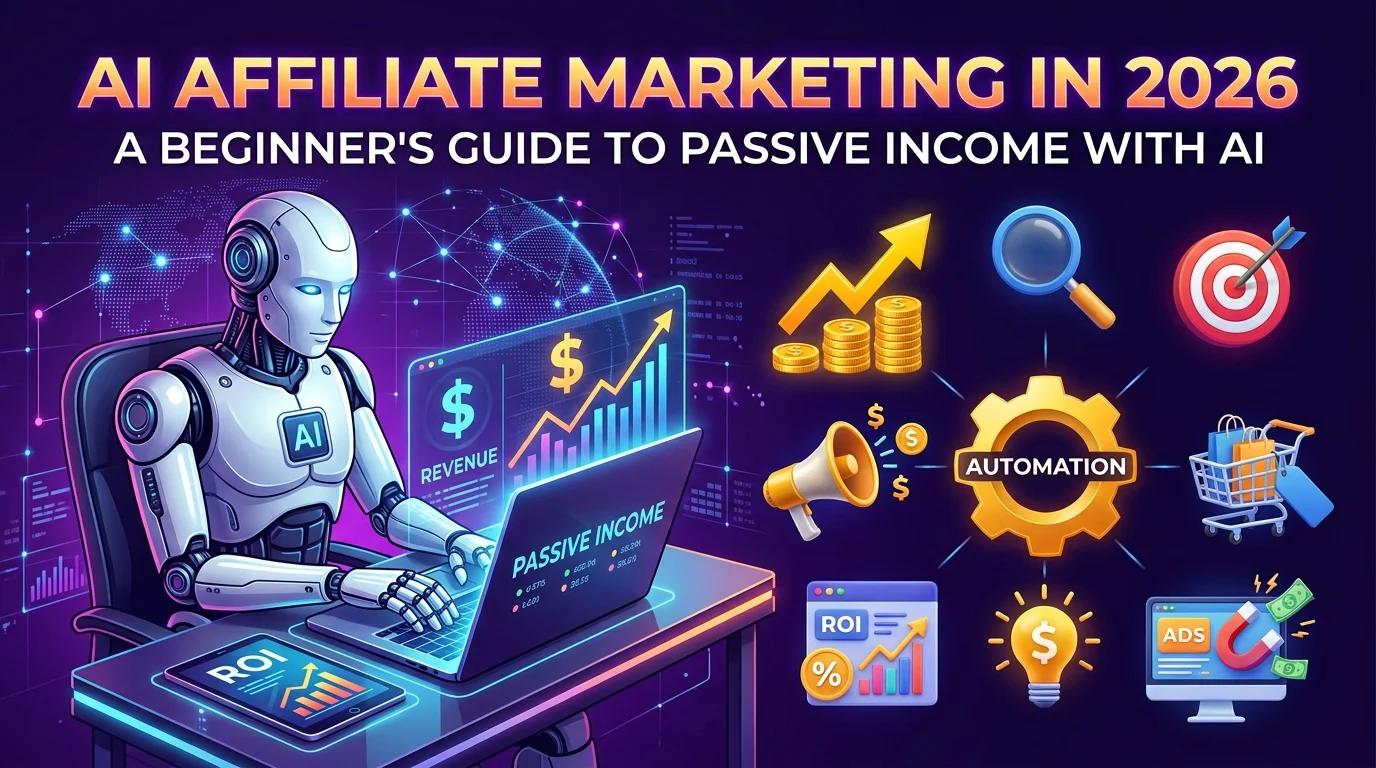
AI Affiliate Marketing in 2026: Complete Beginner’s Guide to Making Passive Income with AI
AI affiliate marketing has become one of the fastest-growing ways to build passive income online in 2026. Thanks to advanced AI tools and autonomous AI agents, beginners can now create content faster, automate repetitive tasks, optimize SEO, and grow affiliate businesses with far less manual work than ever before.
Traditional affiliate marketing still works, but it often requires hours of keyword research, content creation, campaign optimization, and performance tracking. Artificial intelligence is changing that process by helping marketers make smarter decisions, improve productivity, and focus on strategies that generate long-term results instead of spending countless hours on repetitive work.
Whether you’re starting your first affiliate website, growing an existing blog, or looking for new ways to make money with AI, this guide will walk you through everything you need to know. You’ll discover how AI affiliate marketing works, the best AI affiliate programs to join, essential AI tools, proven SEO strategies, common beginner mistakes to avoid, and practical steps to build a scalable affiliate business.
You’ll also learn how AI agents are transforming affiliate marketing in 2026, why Google still rewards high-quality human-reviewed AI content, and how successful marketers combine automation with real expertise to create sustainable passive income.
By the end of this guide, you’ll have a clear roadmap for launching and growing an AI-powered affiliate marketing business that is built for the future—not just for today’s trends.
| Traditional Affiliate Marketing | AI Affiliate Marketing |
|---|---|
| Manual keyword research | AI-powered keyword research |
| Hours of content writing | AI-assisted content creation |
| Manual SEO optimization | AI-driven SEO recommendations |
| Time-consuming campaign analysis | Automated AI insights |
| Limited personalization | AI-powered personalized marketing |
| Slower business growth | Faster and more scalable workflows |
What is AI Affiliate Marketing?
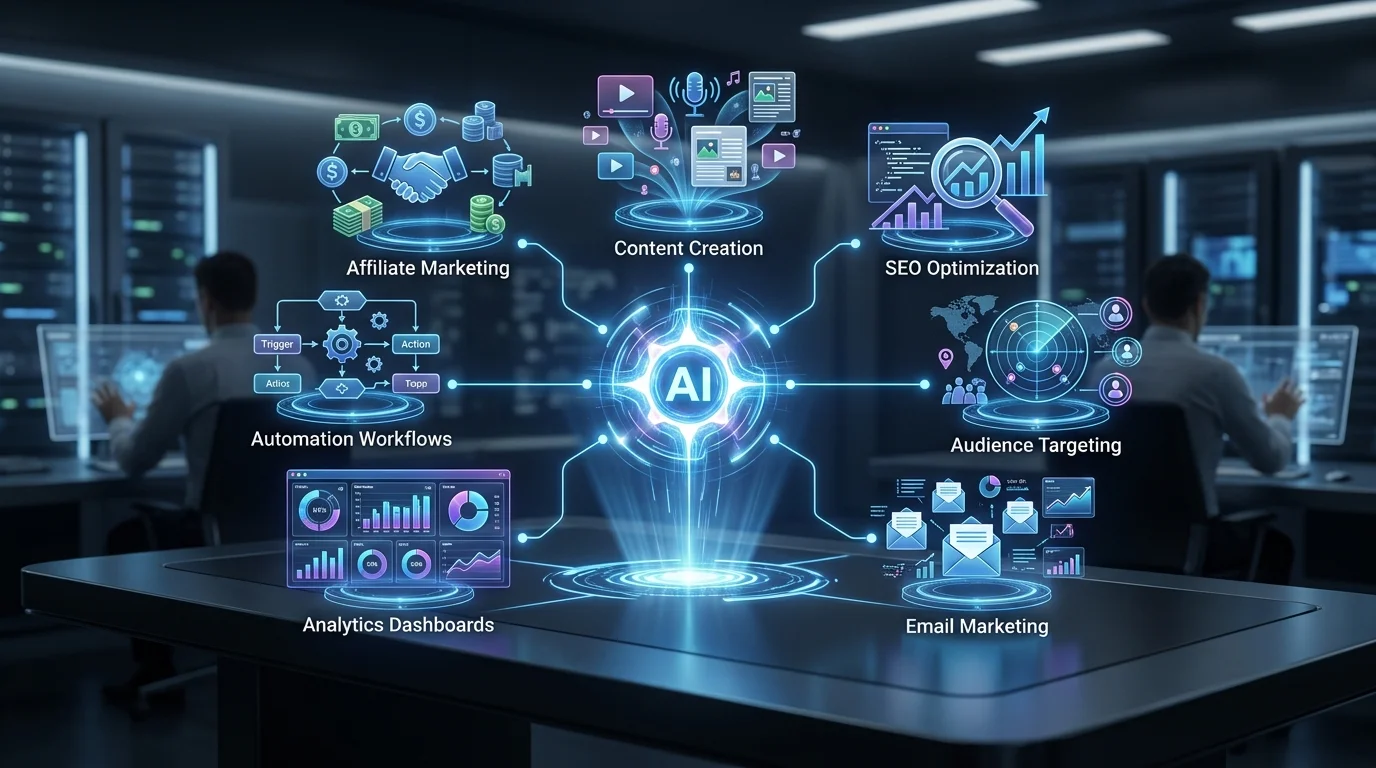
At its core, AI affiliate marketing is the strategic integration of artificial intelligence technologies into the traditional affiliate marketing model to enhance efficiency, personalization, and profitability. It’s not merely about using an AI writing tool to generate content; it’s about deploying intelligent systems across the entire affiliate lifecycle, from market research and audience targeting to content creation, promotion, and performance analysis. This paradigm shift moves beyond manual, labor-intensive processes, allowing marketers to operate at a scale and with a precision previously unattainable.
The fundamental mechanics remain the same as traditional affiliate marketing: you promote a product or service, and when a sale or lead is generated through your unique affiliate link, you earn a commission. However, the ‘how’ is profoundly different. AI introduces capabilities that transform every stage. For instance, instead of manually sifting through market trends, AI can analyze vast datasets to identify emerging niches and profitable products. Instead of guessing audience preferences, AI can segment audiences with granular accuracy and predict conversion likelihood. This allows for highly targeted campaigns that resonate deeply with potential customers, leading to higher conversion rates and, consequently, greater AI affiliate income.
Key Takeaway
AI affiliate marketing doesn’t replace traditional affiliate marketing—it enhances it through automation, data analysis, and intelligent decision-making, allowing marketers to scale faster while focusing on strategy.
| Traditional Affiliate Marketing | AI Affiliate Marketing |
|---|---|
| Manual keyword research | AI-powered keyword research |
| Manual content writing | AI-assisted content creation |
| Manual SEO optimization | AI SEO recommendations |
| Generic marketing campaigns | Personalized AI campaigns |
| Manual analytics | Real-time AI insights |
| Slow scaling | Faster business growth |
How AI Differs from Traditional Affiliate Marketing
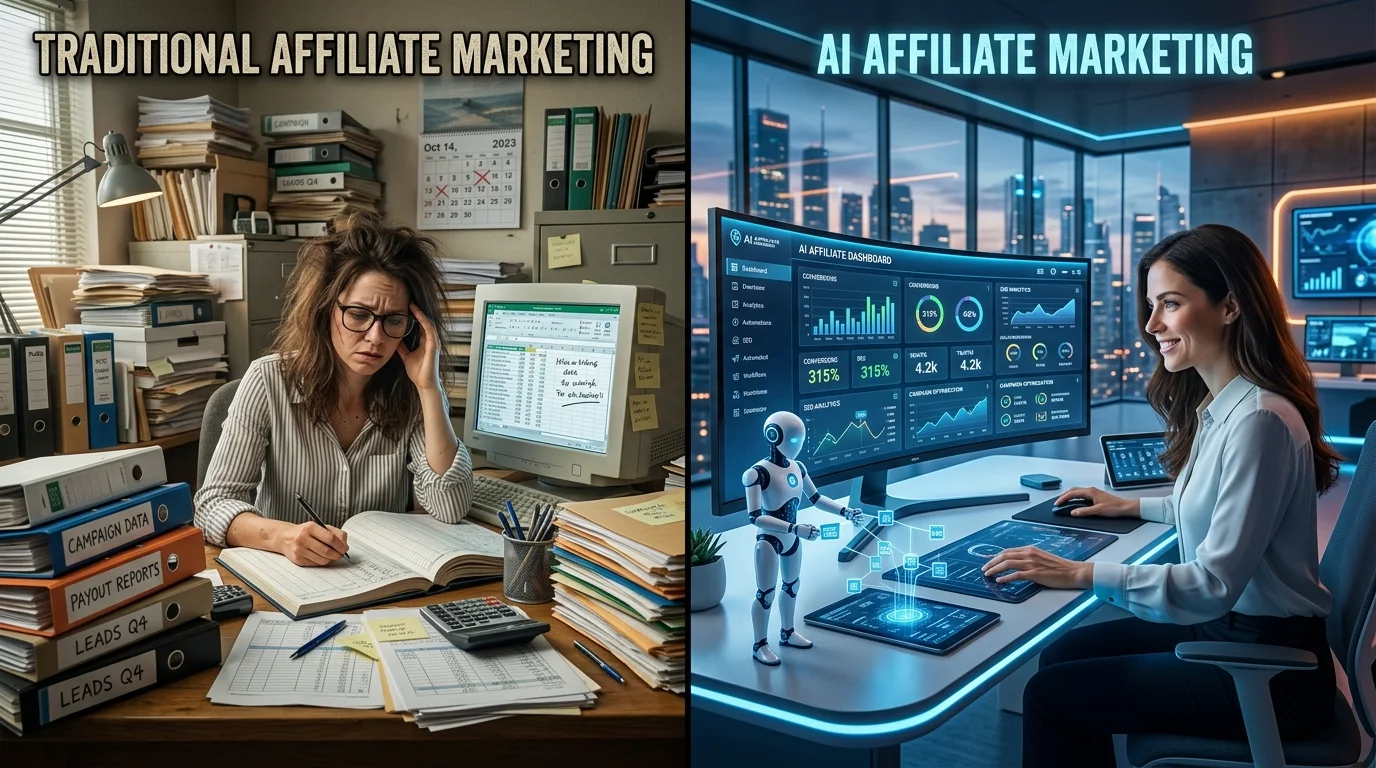
The distinction between AI-driven and traditional affiliate marketing can be summarized by three transformative pillars: Automation, Personalization, and Prediction. These aren’t just buzzwords; they represent fundamental shifts in operational strategy.
- 1. Automation: In traditional affiliate marketing, tasks like keyword research, content drafting, email sequencing, and ad management often require significant human intervention. AI automates these repetitive and time-consuming tasks. AI agents, for example, can autonomously generate multiple content variations, schedule social media posts, or even manage bidding strategies for paid traffic. This frees up the affiliate marketer to focus on higher-level strategy, creative oversight, and relationship building.
- 2. Personalization: Generic marketing messages are increasingly ineffective. AI excels at hyper-personalization. It can analyze user behavior, demographics, and past interactions to deliver tailored product recommendations, customized email content, and dynamic landing pages. This level of personalization creates a more engaging and relevant experience for the potential customer, significantly boosting conversion rates. Imagine an AI dynamically adjusting your website’s product display based on a visitor’s real-time browsing history—that’s the power of AI personalization.
- 3. Prediction: One of AI’s most powerful contributions is its ability to predict future outcomes based on historical data. AI algorithms can forecast market trends, identify potential high-converting leads, predict optimal times for content publication, and even anticipate customer churn. This predictive capability allows affiliate marketers to make data-driven decisions, optimize campaigns proactively, and allocate resources more effectively, moving from reactive adjustments to strategic foresight.
The combination of automation, personalization, and predictive analytics is what makes AI affiliate marketing significantly more scalable than traditional affiliate marketing. Rather than replacing marketers, AI allows them to spend more time on strategy, creativity, and business growth.
A Day in the Life of an AI Affiliate Marketer
| Time | AI Task | Human Role |
|---|---|---|
| Morning | AI researches trending keywords | Review keyword opportunities |
| Content Creation | AI drafts articles | Edit and add expertise |
| SEO | AI suggests optimization | Approve and improve content |
| Promotion | AI schedules social posts | Engage with followers |
| Analytics | AI analyzes campaign performance | Make strategic decisions |
In practice, successful affiliate marketers don’t rely entirely on AI. They combine AI automation with human expertise, fact-checking, and strategic decision-making to produce content that builds trust and long-term authority.
Why AI Affiliate Marketing in 2026?
The question isn’t whether AI will impact affiliate marketing, but how profoundly it already has and will continue to do so in 2026. Several converging factors make this year a critical juncture for anyone looking to enter or scale their efforts in the affiliate space. The sheer pace of technological advancement, coupled with significant shifts in the digital advertising ecosystem, positions AI as not just an advantage, but a necessity for sustained success.
Market Growth and Projections: The Digital Gold Rush Continues
The digital economy is experiencing unprecedented growth, with e-commerce sales projected to hit a staggering $6.88 trillion in 2026 . This expansive market provides a fertile ground for affiliate marketers. AI allows individuals to tap into this growth more effectively by identifying micro-trends, optimizing product placements, and personalizing the shopping experience for potential customers. Imagine an AI analyzing millions of consumer data points to pinpoint exactly which products are about to trend in a specific demographic, allowing you to position your affiliate offers perfectly before the competition catches on. This predictive power is a cornerstone of maximizing passive income with AI.
Furthermore, the affiliate marketing industry itself is booming. Reports indicate a consistent upward trajectory, driven by brands seeking cost-effective, performance-based marketing channels. As competition intensifies, the ability to leverage AI for superior targeting, content creation, and conversion optimization becomes a decisive differentiator. Those who embrace AI early are not just participating in the market; they are actively shaping its future.
The Decline of Cookies and the Rise of AI-Driven Attribution
One of the most significant shifts impacting digital marketing in 2026 is the impending deprecation of third-party cookies. Google’s phase-out, set to complete in Q3 2026, marks the end of an era for traditional tracking and attribution methods 2. This change presents both a challenge and an immense opportunity for AI affiliate marketers.
In a cookie-less world, the reliance on privacy-centric alternatives like Google’s Privacy Sandbox (including Topics API, Federated Learning of Cohorts, and Attribution Reporting API) will become paramount. While this shift may initially reduce deterministic cookie-based attribution accuracy by 8–15% , it simultaneously elevates the importance of AI-driven solutions. AI can analyze anonymized data, contextual signals, and first-party data to provide sophisticated attribution modeling, ensuring that affiliate efforts are accurately credited. Marketers who have already transitioned to server-to-server (S2S) tracking via postbacks and are collecting robust first-party data will gain a significant competitive edge, as AI can then leverage this data for more precise targeting and optimization.
The “First-Party Data” Advantage
With the decline of third-party cookies, first-party data becomes an invaluable asset. This includes data collected directly from your audience through email sign-ups, SMS subscriptions, loyalty programs, and direct interactions on your owned platforms. AI plays a crucial role in collecting, analyzing, and activating this data. For instance, an AI can segment your email list based on engagement patterns and purchase history, allowing for highly personalized email campaigns that promote relevant affiliate products. This not only improves conversion rates but also builds stronger, more trusting relationships with your audience, which is vital for long-term AI affiliate income.
AI-powered analytics can identify patterns and insights within your first-party data that would be impossible for a human to discern. It can predict which content pieces resonate most with specific segments, which products are most likely to be purchased, and even the optimal time to send a promotional email. This deep understanding of your audience, facilitated by AI, allows for a level of precision in your marketing efforts that directly translates into increased profitability and a more sustainable affiliate business model.
Internal Link: How to Make Money with AI in 2026
For a deeper dive into the broader landscape of AI-driven income generation, explore our comprehensive guide on How to Make Money with AI in 2026. This resource provides foundational knowledge that complements the specific strategies discussed here for AI affiliate marketing, offering a holistic view of the opportunities available in the AI-powered economy.
How to Get Started: Step-by-Step Guide
Embarking on your journey into AI affiliate marketing might seem daunting, but breaking it down into manageable steps makes the process clear and actionable. This guide is designed to take you from a beginner to a strategic operator, leveraging AI at every stage to build a sustainable and profitable affiliate business.
Step 1: Choosing Your Niche
The foundation of any successful affiliate marketing strategy is selecting the right niche. In 2026, the most profitable niches are those where AI can provide a distinct advantage or where the products themselves are AI-driven.
- AI SaaS (Software as a Service): This is arguably the most lucrative niche right now. Promoting AI tools for productivity, coding (like Claude Code, v0, Replit), marketing, and business operations offers high recurring commissions. The demand for these tools is skyrocketing, making it an ideal space for AI software affiliate programs.
- Smart Tech and IoT: Niches like portable power stations, smart pet tech, cold plunge recovery gear, and home EV charging stations are experiencing rapid growth. AI can help you identify micro-trends within these broader categories and target specific consumer segments effectively.
- iGaming and Forex: These industries are highly competitive but offer substantial rewards. AI is crucial here for sophisticated fraud detection, optimizing ad spend, and personalizing user experiences to maximize conversions.
- E-commerce and Retail: With global e-commerce sales projected to reach $6.88 trillion in 2026 1, promoting physical products remains viable. AI can assist in dynamic pricing analysis, personalized product recommendations, and identifying high-converting long-tail keywords.
When choosing your niche, consider your own interests and expertise. While AI can help you learn quickly, having a foundational understanding of the topic will make content creation and audience engagement more authentic and effective.
Step 2: Selecting the Right AI Affiliate Programs
Once you’ve chosen your niche, the next step is to select the best affiliate programs. Not all programs are created equal. You want to look for programs that offer competitive commission rates, reliable tracking, and products that genuinely provide value to your audience.
When evaluating programs, consider the commission structure. Recurring commissions (where you earn a percentage of the customer’s subscription fee every month) are generally more desirable than one-time payouts, as they build a more stable foundation for passive income with AI. Also, look for programs with long cookie durations, ensuring you get credited for sales even if the customer doesn’t purchase immediately.
- Jasper AI: Offers a generous 30% recurring commission. It’s a leading AI writing assistant, making it an easy sell to content creators and marketers.
- Surfer SEO: Provides high-paying recurring commissions. Essential for anyone serious about SEO, making it a staple in the AI blogging affiliate marketing toolkit.
- Hostinger: While not exclusively AI, their AI-powered hosting solutions are highly attractive to beginners setting up their first websites.
- InVideo AI / Pictory: Excellent for the video creation niche, offering tools that simplify video production, which is increasingly important for engagement.
Step 3: Setting Up Your “AI Agent” Infrastructure
In 2026, we are moving beyond simply using AI tools to deploying AI agents. An AI agent is a system designed to perform specific tasks autonomously within a defined workflow. Setting up this infrastructure is crucial for scaling your efforts.
- Identify Repetitive Tasks: Start by identifying the tasks that consume the most time, such as keyword research, drafting initial content outlines, or scheduling social media posts.
- Select the Right Tools: Choose AI platforms that support agentic workflows. Tools like Writer, custom GPTs, or automation platforms like N8N and Zapier are essential.
- Train Your Agents: This is the most critical step. You must train your AI agents on your brand voice, specific SEO requirements, and the nuances of your chosen niche. The more focused the training, the better the output. For example, you might have one agent dedicated solely to generating SEO-optimized product descriptions and another for drafting email newsletters.
- Establish Human Oversight: AI agents are powerful, but they are not infallible. Establish a workflow where human review is mandatory before any content is published or any campaign is launched. This ensures quality control and maintains the authenticity of your brand.
Step 4: Content Creation Strategy (Blogging, Video, Social)
Content is the vehicle through which you promote your affiliate links. Your strategy should be multi-channel, leveraging AI to produce high-quality content efficiently.
- Blogging: Use AI tools like Jasper or Writesonic to draft articles, but ensure you inject your own expertise and experience to meet Google’s EEAT guidelines. Use Surfer SEO to optimize the content for search engines. Focus on comprehensive guides, “how-to” articles, and detailed product reviews.
- Video: Video content is highly engaging. Use tools like InVideo AI or Pictory to turn your blog posts into engaging videos for YouTube or social media. AI can help with scriptwriting, voiceovers, and even generating visuals.
- Social Media: AI can help you maintain a consistent presence across platforms. Use AI to generate social media captions, create eye-catching graphics (using tools like Midjourney or Adobe Firefly), and schedule posts for optimal times.
Internal Link: Best AI Tools for Beginners in 2026
To equip yourself with the right arsenal, check out our comprehensive guide on the Best AI Tools for Beginners in 2026. This resource provides detailed reviews and recommendations for the tools that will form the foundation of your AI affiliate marketing strategy.
Top AI Affiliate Programs in 2026

Choosing the right affiliate programs is paramount to your success in AI affiliate marketing. In 2026, the market is flooded with AI tools and services, making it both an opportunity and a challenge to identify programs that offer genuine value, competitive commissions, and a strong product-market fit. This section highlights some of the leading best AI affiliate programs that are poised for growth and offer excellent opportunities for AI affiliate income.
When evaluating an AI affiliate program, consider the following:
- Commission Structure: Look for recurring commissions, which provide a stable and growing passive income stream. One-time payouts can be good for high-ticket items, but recurring revenue builds long-term wealth.
- Product Quality and Demand: Promote products you genuinely believe in and that solve real problems for your audience. High-quality tools with strong demand are easier to sell and lead to higher conversion rates.
- Cookie Duration: A longer cookie duration means you have more time to earn a commission after a user clicks your link. Look for 30-day or longer cookie windows.
- Support and Resources: Good affiliate programs offer marketing materials, dedicated support, and clear tracking dashboards.
Here are some of the top AI affiliate programs to consider in 2026:
Detailed Reviews of Leading AI Affiliate Programs
- Jasper AI
- Overview: Jasper is a powerful AI writing assistant that helps content creators, marketers, and businesses generate high-quality content quickly. It excels at blog posts, marketing copy, social media content, and more.
- Why Promote It: High demand in the content creation space, excellent product, and a generous 30% recurring commission. This makes it a prime choice for AI blogging affiliate marketing.
- Target Audience: Bloggers, content marketers, agencies, small business owners.
- Surfer SEO
- Overview: Surfer SEO is an on-page SEO optimization tool that helps users create content that ranks higher on Google. It analyzes top-ranking pages and provides data-driven recommendations for content structure, keywords, and readability.
- Why Promote It: Essential for anyone serious about SEO, especially with Google’s continued emphasis on helpful content. Offers high recurring commissions.
- Target Audience: SEO professionals, content writers, digital marketing agencies, bloggers.
- Hostinger
- Overview: Hostinger provides affordable web hosting services, including AI-powered website builders and tools. They focus on speed, reliability, and ease of use.
- Why Promote It: High conversion rates due to competitive pricing and strong brand recognition. Ideal for beginners looking to launch their first website or blog. While not exclusively an AI tool, their integration of AI features makes them relevant for AI affiliate marketing.
- Target Audience: Small businesses, bloggers, startups, individuals looking to create a website.
- TubeBuddy
- Overview: TubeBuddy is a YouTube channel management and optimization toolkit that helps creators grow their channels. It offers tools for keyword research, video SEO, bulk processing, and analytics.
- Why Promote It: With the rise of video content, TubeBuddy is an indispensable tool for YouTubers. Offers up to 50% recurring commission, making it highly attractive.
- Target Audience: YouTube creators, video marketers, social media managers.
- OutlierKit
- Overview: OutlierKit provides AI-powered tools for e-commerce analytics and optimization, helping online stores identify trends, improve product listings, and boost sales.
- Why Promote It: Addresses a critical need for e-commerce businesses. Offers a solid 30% recurring commission.
- Target Audience: E-commerce store owners, dropshippers, online retailers.
- Reclaim.ai
- Overview: Reclaim.ai is an intelligent calendar and productivity app that uses AI to automatically find the best time for your tasks, meetings, and habits. It integrates with Google Calendar and other tools.
- Why Promote It: Solves a common pain point (time management) with an innovative AI solution. Backed by Dropbox, indicating reliability and potential for growth.
- Target Audience: Professionals, freelancers, remote workers, anyone seeking productivity improvements.
- AdCreative.ai
- Overview: AdCreative.ai uses AI to generate high-performing ad creatives and headlines. It helps businesses create visually appealing and conversion-focused ads for various platforms.
- Why Promote It: Directly impacts advertising ROI, a key metric for businesses. High demand for effective ad creation solutions.
- Target Audience: Advertisers, marketing agencies, e-commerce businesses, startups.
- InVideo AI / Pictory
- Overview: These platforms leverage AI to simplify video creation, allowing users to turn text into engaging videos with voiceovers, stock footage, and music. Pictory focuses on short, shareable video clips, while InVideo AI offers more comprehensive editing.
- Why Promote It: Video content is king, and these tools make it accessible to everyone. Great for content creators, marketers, and businesses looking to produce video at scale.
- Target Audience: Content creators, social media marketers, small businesses, educators.
Comparison Table: Top AI Affiliate Programs (2026)
| Program Name | Primary Function | Commission Type | Commission Rate | Cookie Duration | Target Audience |
|---|---|---|---|---|---|
| Jasper AI | AI Writing Assistant | Recurring | 30% | 30 days | Content Creators, Marketers, Businesses |
| Surfer SEO | On-Page SEO Optimization | Recurring | High | 30 days | SEO Professionals, Content Writers, Agencies |
| Hostinger | Web Hosting (AI features) | One-time | Up to $150 | 30 days | Beginners, Bloggers, Small Businesses |
| TubeBuddy | YouTube Optimization | Recurring | Up to 50% | 30 days | YouTube Creators, Video Marketers |
| OutlierKit | E-commerce Analytics | Recurring | 30% | 30 days | E-commerce Store Owners, Online Retailers |
| Reclaim.ai | AI Calendar/Productivity | Recurring | Varies | 30 days | Professionals, Freelancers, Productivity Seekers |
| AdCreative.ai | AI Ad Creative Generator | Recurring | Varies | 30 days | Advertisers, Marketing Agencies, E-commerce |
| InVideo AI | AI Video Creator | Recurring | Varies | 30 days | Content Creators, Social Media Marketers |
| Pictory | AI Short Video Creator | Recurring | Varies | 30 days | Content Creators, Social Media Marketers |
Note: Commission rates and terms can change. Always verify the latest details on the program’s official website.
Essential AI Tools for Affiliate Marketers
In the dynamic world of AI affiliate marketing, having the right tools is not just an advantage—it’s a necessity. These tools empower you to automate repetitive tasks, optimize your content for maximum reach, personalize your outreach, and analyze performance with precision. While the market is flooded with options, focusing on a core set of essential AI tools will streamline your workflow and amplify your results. This section will categorize and highlight the indispensable AI marketing tools for any aspiring or established AI affiliate marketer in 2026.
1. Content Creation and Optimization Tools
Content remains king, but AI has revolutionized its production and optimization. These tools help you generate high-quality, SEO-friendly content at scale.
- Jasper AI: As mentioned in the affiliate programs section, Jasper is a leading AI writing assistant. It can generate blog posts, social media captions, ad copy, and even entire articles. Its ability to adapt to various tones and styles makes it invaluable for maintaining brand consistency while scaling content production. For AI blogging affiliate marketing, Jasper can significantly reduce the time spent on initial drafts, allowing you to focus on refining and adding your unique voice.
- Surfer SEO: This tool is crucial for on-page SEO optimization. Surfer analyzes top-ranking content for your target keywords and provides data-driven recommendations for content length, keyword density, heading structure, and internal linking opportunities. Integrating Surfer SEO into your content workflow ensures that your AI-generated or human-written content is optimized to rank high on search engines.
- Writesonic: Similar to Jasper, Writesonic offers a suite of AI writing tools for various content formats, including articles, landing pages, and product descriptions. It’s particularly strong in generating marketing copy that converts, making it a valuable asset for affiliates creating promotional materials.
- Copy.ai: Specializing in short-form copy, Copy.ai is excellent for generating headlines, social media posts, email subject lines, and ad copy. Its intuitive interface and wide range of templates make it easy for beginners to produce compelling marketing messages quickly.
2. Visual Content Generation Tools
Engaging visuals are critical for capturing attention and conveying messages effectively. AI has made high-quality image and video creation accessible to everyone.
- Midjourney / Adobe Firefly: These AI image generators allow you to create stunning, original images from text prompts. Whether you need a hero image for a blog post, an infographic element, or social media graphics, these tools can produce unique visuals that stand out. Adobe Firefly, in particular, offers robust features for commercial use and integration with other Adobe products.
- InVideo AI / Pictory: For video content, these tools are game-changers. InVideo AI can help you create professional-looking videos from scripts or blog posts, complete with stock footage, music, and voiceovers. Pictory specializes in transforming long-form content into short, shareable video clips, perfect for social media platforms like TikTok and Instagram Reels. These tools are essential for diversifying your content strategy and reaching audiences on video-first platforms.
3. Automation and Workflow Management Tools
Automation is the backbone of passive income with AI. These tools connect your various applications and automate repetitive tasks, allowing your AI agents to function seamlessly.
- N8N / Zapier: These are powerful automation platforms that allow you to connect different web services and automate workflows without writing code. For example, you can set up an automation where a new blog post (generated by Jasper) is automatically pushed to your social media scheduler, an email newsletter draft is created, and a performance tracking event is logged. N8N offers more self-hosting flexibility, while Zapier is known for its ease of use and extensive integrations.
- Gemini / ChatGPT (for custom agents): While primarily known as chatbots, advanced versions of these large language models can be configured to act as specialized AI agents. You can train them on your specific brand guidelines, content requirements, and audience personas to perform tasks like generating content outlines, summarizing research, or even responding to basic customer inquiries. This moves beyond simple prompt engineering to creating truly autonomous assistants.
4. Tracking and Analytics Tools
Understanding your performance is crucial for optimization. These tools provide insights into your campaigns and help you make data-driven decisions.
- Voluum / Track360: These are robust affiliate tracking platforms that provide comprehensive data on clicks, conversions, revenue, and ROI. They are essential for monitoring the effectiveness of your campaigns, identifying profitable traffic sources, and detecting fraud. In a post-cookie world, these platforms are adapting to new attribution models, making them even more critical for accurate performance measurement.
- Google Analytics 4 (GA4): While not strictly an AI tool, GA4 leverages AI and machine learning for predictive analytics and more user-centric data collection. It helps you understand user behavior on your website, identify trends, and optimize your content and user experience. Integrating GA4 with your affiliate tracking platform provides a holistic view of your marketing ecosystem.
Internal Link: Best AI Tools for Beginners in 2026
For a more detailed breakdown and hands-on guidance on leveraging these and other powerful AI tools, refer to our guide on the Best AI Tools for Beginners in 2026. This resource will help you select and implement the right tools to kickstart your AI affiliate marketing journey.
Advanced Strategies: Using AI Agents

As you progress beyond the foundational stages of AI affiliate marketing, the distinction between merely using AI tools and strategically deploying AI agents becomes critical. While AI tools assist with specific tasks, AI agents are designed to operate autonomously within defined workflows, making decisions and executing actions to achieve a broader objective. This shift represents a significant leap in efficiency and scalability, moving you closer to true passive income with AI.
Moving from “Tools” to “Agents”
Think of it this way: an AI writing tool is like a sophisticated hammer—it performs a specific function when you wield it. An AI agent, however, is like a robotic carpenter that can not only use the hammer but also saw, measure, and assemble, following a blueprint to build an entire structure. AI agents are characterized by their ability to:
- Autonomy: They can initiate tasks and make decisions without constant human oversight.
- Goal-Oriented: They are programmed to achieve specific objectives, such as generating SEO-optimized content or managing social media campaigns.
- Learning and Adaptation: Many advanced agents can learn from their interactions and data, improving their performance over time.
- Workflow Integration: They seamlessly integrate multiple tools and processes to complete complex tasks.
This evolution from tools to agents is what will truly differentiate successful AI affiliate marketers in 2026. Instead of manually prompting an AI to write a blog post, an AI content agent can be tasked with researching a topic, drafting the content, optimizing it for SEO, and even scheduling its publication, all with minimal human intervention.
Case Study: How Adore Me Used AI Agents for 40% SEO Growth
A compelling real-world example of the power of AI agents comes from Adore Me, a direct-to-consumer lingerie brand. Faced with the challenge of scaling content production across product descriptions, multilingual website copy, and stylist notes without increasing headcount, Adore Me turned to AI agents .
They utilized Writer’s AI Studio to build role-specific AI agents. One agent was meticulously trained to generate SEO-optimized product descriptions in their distinct brand tone. Another handled Spanish translations for their Mexico market launch, ensuring cultural and linguistic accuracy. A third agent drafted personalized stylist notes, which human stylists then refined and approved.
The results were transformative: Adore Me reduced the time spent on stylist note writing by 36% and slashed the time for generating product descriptions from 20 hours to just 20 minutes per batch. Their localized launch time, which previously took months, was reduced to a mere 10 days. Most notably, they achieved a 40% increase in non-branded SEO traffic . This demonstrates how specialized AI agents, working autonomously within defined workflows, can drive significant business outcomes and directly contribute to AI affiliate income by boosting organic visibility.
Setting Up Your First Content Agent
For beginners, setting up your first AI content agent can be a game-changer for AI blogging affiliate marketing. Here’s a simplified approach:
- Define a Specific Workflow: Start with a single, repeatable content task. A good example is generating blog post outlines or drafting product reviews for a specific category.
- Choose Your Platform: Platforms like Writer, custom GPTs (available through OpenAI), or even advanced configurations within tools like Gemini or Claude can serve as the foundation for your agent. Automation tools like N8N or Zapier can then connect these AI models to other parts of your workflow (e.g., your CMS, social media scheduler).
- Train with Your Data: This is where the “Experience” and “Expertise” components of EEAT come into play. Feed your agent examples of your best-performing content, your brand style guide, and specific SEO requirements (e.g., target keywords, desired tone, internal linking strategies). The more context and high-quality examples you provide, the better the agent’s output will be.
- Establish Guardrails and Review Processes: Implement clear rules for your agent. For instance, it might generate a draft, but human review and approval are always required before publication. This ensures quality, factual accuracy, and alignment with your brand voice. Regularly review the agent’s output and provide feedback to continuously refine its performance.
- Iterate and Expand: Once your first content agent is performing reliably, you can gradually expand its capabilities or create new agents for other tasks, such as social media content generation, email marketing copy, or even basic customer support responses related to your affiliate products.
By strategically implementing AI agents, you can dramatically increase your content output, improve its quality and SEO performance, and free up your time to focus on higher-level strategic planning and audience engagement, ultimately accelerating your journey towards substantial AI affiliate income.
SEO & EEAT for AI Content
In the competitive landscape of 2026, simply generating content with AI is not enough. To achieve high rankings, attract organic traffic, and appear in coveted spots like Google Discover, your content must adhere to Google’s stringent quality guidelines, particularly the Helpful Content Update and the expanded E-E-A-T framework. This section will guide you on how to optimize your AI-assisted content to meet these critical standards, ensuring your AI blogging affiliate marketing efforts are rewarded.
Google’s Helpful Content Guidelines: People-First Content
Google’s Helpful Content Update, which saw significant iterations leading into 2026, emphasizes one core principle: content should be created for people, not for search engines . This means your articles must:
- Provide genuine value: Does your content answer a user’s question thoroughly? Does it solve a problem? Does it offer a unique perspective or insight?
- Demonstrate expertise: Is the content written by or reviewed by someone with demonstrable knowledge in the subject matter?
- Be original and comprehensive: Avoid generic, surface-level information. Dive deep into topics, offering complete coverage that leaves no stone unturned.
- Avoid “AI Slop”: Google has made it clear that mass-produced, low-quality AI content designed solely to manipulate rankings will be penalized. While AI is a powerful assistant, it should not be used to churn out unoriginal or unhelpful content. The goal is to use AI to enhance human expertise, not replace it entirely.
To comply, conduct thorough content audits, remove or revise low-quality material, and consistently focus on delivering value to users. Avoid keyword stuffing and instead prioritize natural language that addresses user intent comprehensively .
The “Experience” Factor: The New E-E-A-T
Google’s E-A-T (Expertise, Authoritativeness, Trustworthiness) framework evolved into E-E-A-T with the addition of Experience. This fourth ‘E’ is particularly crucial for AI-generated content in 2026, as it directly addresses the challenge of distinguishing authentic, human-quality content from generic AI output 6.
- Experience: This means demonstrating first-hand experience with the topic. For an AI affiliate marketer, this could involve personally testing the AI tools you recommend, sharing screenshots of your results, detailing your workflow, or recounting personal anecdotes related to using the product. For example, instead of just listing features of an AI writing tool, describe how you used it to draft a blog post, the challenges you faced, and the specific benefits you observed. This personal touch builds credibility and resonates deeply with readers.
- Expertise: Show that you have deep knowledge in your niche. This can be conveyed through detailed explanations, nuanced discussions, and the ability to anticipate and answer complex questions. Your content should reflect a profound understanding of AI affiliate marketing, not just a superficial overview.
- Authoritativeness: Position yourself or your brand as a go-to source for information. This is built over time through consistent publication of high-quality content, being cited by other reputable sources, and having a strong online presence. For AI content, this means ensuring your AI agents are trained on authoritative data and that their output is fact-checked and verified.
- Trustworthiness: This is the bedrock of E-E-A-T. Be transparent about your affiliate relationships, provide accurate information, and back up your claims with evidence. Clear authorship, contact information, and a privacy policy contribute to trustworthiness. For AI-assisted content, this means taking full responsibility for the accuracy and helpfulness of the final output, regardless of how it was generated.
Rank Math Optimization Checklist
Rank Math is a powerful WordPress SEO plugin that can help you implement many of these SEO best practices. Optimizing your content with Rank Math involves more than just getting a green score; it’s about aligning with search engine algorithms and user expectations.
- Focus Keyword and Secondary Keywords: Ensure your primary keyword (AI Affiliate Marketing) and secondary keywords (AI affiliate marketing in 2026, make money with AI affiliate marketing, best AI affiliate programs, AI affiliate programs, passive income with AI, AI affiliate income, AI software affiliate programs, AI blogging affiliate marketing, AI marketing tools) are naturally integrated throughout your content, especially in headings, introduction, and conclusion. Avoid keyword stuffing; focus on semantic relevance.
- Content AI Suggestions: Leverage Rank Math’s Content AI feature to get suggestions for additional keywords, questions, and links to include. This helps ensure comprehensive coverage of your topic.
- Readability: Aim for short paragraphs, use active voice, and break up long sentences. Rank Math provides readability scores and suggestions to improve user experience, which indirectly impacts SEO.
- Schema Markup: Implement relevant schema types like FAQ Schema for your FAQ section, How-To Schema for step-by-step guides, and Article Schema. This helps search engines understand your content better and can lead to rich snippets in search results.
- Internal Linking: Strategically link to other relevant articles on your site, such as “How to Make Money with AI in 2026” or “Best AI Tools for Beginners in 2026.” This improves site navigation, distributes link equity, and keeps users engaged longer. Rank Math can help identify internal linking opportunities.
- External Linking: Link out to authoritative sources to back up your claims and demonstrate thorough research. This enhances your content’s trustworthiness and expertise.
- Meta Title and Description: Craft compelling meta titles and descriptions that include your primary keyword and entice users to click. Rank Math allows easy editing of these elements.
Avoiding the “AI Slop” Penalty
In 2026, the distinction between helpful AI-assisted content and unhelpful “AI slop” is clearer than ever. To avoid penalties and ensure your content ranks, always prioritize:
- Human Oversight: Every piece of content, regardless of its AI origin, must be reviewed, edited, and enhanced by a human expert. Add personal insights, unique examples, and a distinct voice.
- Fact-Checking: AI models can sometimes hallucinate or provide outdated information. Always verify facts, statistics, and claims.
- Originality: Ensure your content offers a fresh perspective or deeper insights than what’s already available. Don’t just rephrase existing articles.
- User Intent: Focus relentlessly on satisfying the user’s intent behind their search query. If your content genuinely helps users, it aligns with Google’s goals.
By diligently applying these SEO and E-E-A-T principles, you can harness the power of AI to create content that not only ranks but also builds trust and authority with your audience, driving sustainable AI affiliate income.
Beginner Mistakes to Avoid
Venturing into AI affiliate marketing in 2026 offers immense potential, but like any promising endeavor, it comes with its share of pitfalls. Many beginners, eager to leverage the power of AI for passive income with AI, can inadvertently make mistakes that hinder their progress or even lead to penalties. Understanding and actively avoiding these common errors is crucial for building a sustainable and profitable AI affiliate business.
1. Over-Automation: Losing the Human Touch
One of the most tempting aspects of AI is its ability to automate. However, a common mistake is to over-automate to the point where your content and interactions lose their human touch. While AI can generate drafts, schedule posts, and even respond to basic queries, relying solely on AI without human oversight often results in generic, unengaging, and ultimately unhelpful content—what Google refers to as “AI slop.” This directly contradicts the E-E-A-T principle, particularly the “Experience” factor.
- How to Avoid: Use AI as an assistant, not a replacement. Always review, edit, and inject your unique voice, insights, and personal experiences into AI-generated content. Engage with your audience authentically, and use AI to free up time for more meaningful human interactions, not to avoid them.
2. Ignoring Compliance: The Legal Landscape of AI and Affiliate Marketing
As AI becomes more prevalent, so do regulations surrounding its use and data privacy. Ignoring compliance with laws like GDPR (General Data Protection Regulation) in Europe, CCPA (California Consumer Privacy Act) in the US, and emerging AI-specific regulations can lead to significant fines and damage to your reputation. Furthermore, transparency in affiliate marketing is non-negotiable; you must clearly disclose your affiliate relationships.
- How to Avoid: Stay informed about data privacy laws and AI regulations relevant to your target audience. Always include clear affiliate disclaimers on your content. Ensure your AI tools and data collection methods are compliant. For example, with the deprecation of third-party cookies, understanding and implementing privacy-preserving attribution methods is vital.
3. Keyword Stuffing vs. Semantic SEO
In the early days of SEO, simply repeating keywords was a common tactic. While AI can help identify keywords, a beginner might mistakenly believe that cramming them into content will improve rankings. In 2026, this approach is detrimental. Google’s algorithms are highly sophisticated, focusing on semantic understanding and user intent rather than keyword density.
- How to Avoid: Focus on creating comprehensive content that naturally addresses the user’s query and related topics. Use AI tools like Surfer SEO to identify semantically related keywords and entities, and integrate them naturally. Prioritize readability and helpfulness over forced keyword placement. Your goal is to answer all aspects of a user’s question, not just mention a keyword multiple times.
4. Relying on a Single Traffic Source
Putting all your eggs in one basket, whether it’s Google organic search, a specific social media platform, or paid ads, is a risky strategy. Algorithm changes, platform policy updates, or even account suspensions can wipe out your AI affiliate income overnight.
- How to Avoid: Diversify your traffic sources. While AI blogging affiliate marketing can be highly effective, also explore YouTube, Pinterest, email marketing, and even paid advertising (leveraging AI for optimization). Building an email list, for instance, gives you a direct communication channel with your audience that you own and control, independent of external platforms.
5. Neglecting Continuous Learning and Adaptation
The AI and affiliate marketing landscapes are evolving at an unprecedented pace. What works today might be obsolete tomorrow. A significant mistake is to set up a system and then neglect to monitor, learn, and adapt.
- How to Avoid: Dedicate time each week to staying updated on AI advancements, Google algorithm changes, and new affiliate marketing strategies. Continuously test and optimize your campaigns. Analyze your data, learn from both successes and failures, and be prepared to pivot your strategies as the market evolves. The most successful AI affiliate marketers are perpetual learners.
By being aware of these common pitfalls and proactively implementing strategies to avoid them, beginners can lay a solid foundation for a successful and resilient AI affiliate marketing business in 2026.
Actionable Tips for Scaling
Once you’ve established a foundational understanding and started generating initial AI affiliate income, the next natural step is to scale your operations. Scaling in AI affiliate marketing isn’t just about doing more of the same; it’s about strategically leveraging AI to expand your reach, diversify your revenue streams, and maximize your efficiency. Here are actionable tips to help you scale your AI affiliate marketing business in 2026.
1. Reinvest Profits Strategically
One of the most common mistakes beginners make is withdrawing all their earnings. To truly scale, you must reinvest a portion of your profits back into your business. This could mean:
- Upgrading AI Tools and Agents: Invest in more advanced AI software, higher-tier subscriptions, or specialized AI agents that offer greater capabilities, speed, or accuracy. For example, upgrading to a premium AI content platform might unlock features like advanced content briefs or deeper competitive analysis.
- Paid Advertising: While organic traffic is excellent, paid ads can significantly accelerate growth. Use AI-powered advertising platforms (like Google Ads with AI bidding or social media ads optimized by AI) to target highly specific audiences. Start with small, controlled budgets and scale up as campaigns prove profitable.
- Content Expansion: Invest in creating more diverse content formats (e.g., video production, podcasting) or expanding into new content clusters. This could involve hiring human writers or video editors to work alongside your AI agents, adding a layer of human creativity and oversight.
- Team Building: As your operations grow, consider hiring virtual assistants or specialized freelancers to manage tasks that are not yet fully automated by AI, or to provide the human touch where it’s most needed (e.g., community management, in-depth content editing).
2. Diversify Your Niches and Programs
Reliance on a single niche or a handful of affiliate programs can be risky. Market shifts, algorithm updates, or changes in program terms can severely impact your income. Diversification is key to building resilience.
- Expand into Related Niches: Once you’ve mastered one niche, use AI to identify adjacent or complementary niches. For example, if you’re successful in AI SaaS, you might expand into AI-powered productivity tools or digital marketing software.
- Join More Affiliate Programs: Don’t limit yourself to just a few programs. Research and join additional best AI affiliate programs that align with your content and audience. This spreads your risk and opens up new revenue opportunities.
- Explore Different Commission Models: While recurring commissions are ideal, also consider high-ticket one-time payouts or pay-per-lead models to balance your income streams.
3. Build and Nurture an Email List: Your Ultimate Asset
An email list is arguably the most valuable asset an affiliate marketer can possess. Unlike social media followers or search engine traffic, your email list is an audience you own and control. It’s a direct line of communication that is immune to algorithm changes or platform policies.
- Leverage AI for List Growth: Use AI-powered tools to create compelling lead magnets (e.g., AI-generated e-books, checklists, or mini-courses), optimize landing page copy for conversions, and personalize sign-up forms.
- Automate Email Sequences: Deploy AI agents to create and manage automated email sequences for onboarding new subscribers, nurturing leads, and promoting affiliate offers. AI can segment your list based on behavior and preferences, ensuring highly relevant content is delivered to each subscriber.
- Personalize Outreach: Use AI to analyze subscriber data and personalize email content, subject lines, and call-to-actions. This significantly increases open rates, click-through rates, and ultimately, conversions.
4. Focus on Community Building and Engagement
In an increasingly AI-driven world, human connection and community become even more valuable. Building a loyal community around your niche can lead to higher engagement, trust, and repeat conversions.
- AI-Assisted Community Management: Use AI tools to monitor social media mentions, identify trending topics within your community, and even draft responses to common questions. This allows you to engage more effectively and at scale.
- Host Live Sessions/Webinars: Leverage AI for scheduling, promotion, and even generating summaries or transcripts of live events. These interactive sessions build rapport and provide opportunities to showcase your expertise and promote affiliate products directly.
- Solicit User-Generated Content: Encourage your audience to share their experiences with the products you promote. AI can help analyze this content for sentiment and identify potential brand advocates.
By implementing these actionable tips, you can strategically scale your AI affiliate marketing efforts, transforming initial successes into a robust and continually growing source of passive income with AI in 2026 and beyond.
Frequently Asked Questions (FAQ)
Navigating the intersection of AI and affiliate marketing can raise many questions, especially for beginners. Here are answers to some of the most common queries regarding AI affiliate marketing in 2026.
1. Is AI affiliate marketing actually profitable in 2026?
Yes, it is highly profitable, but it requires strategy. The landscape has shifted from simply generating content to using AI for deep personalization, predictive analytics, and workflow automation. Those who use AI to enhance the user experience and scale their operations are seeing significant returns.
2. Do I need technical skills to start?
No, you do not need to be a programmer or data scientist. The AI marketing tools available in 2026 are designed with user-friendly interfaces. Tools like Jasper, Surfer SEO, and automation platforms like Zapier require no coding knowledge to operate effectively.
3. Will Google penalize my site for using AI content?
Google penalizes low-quality, unhelpful content, regardless of how it was created. If you use AI to generate generic “slop” just to manipulate rankings, you will likely be penalized. However, if you use AI to assist in creating comprehensive, original, and helpful content that adheres to E-E-A-T guidelines, Google will not penalize you. Human oversight and editing are crucial.
4. What is the best AI affiliate program for beginners?
Programs that offer recurring commissions and have high demand are best. Jasper AI and Surfer SEO are excellent starting points because they are essential tools for other marketers and content creators, making them relatively easy to promote.
5. How much money do I need to start?
You can start with a very low budget. Many AI tools offer free trials or freemium plans. Your primary initial costs will be a domain name and web hosting (like Hostinger). As you start generating AI affiliate income, you can reinvest in premium tools and paid advertising.
6. Can AI completely replace human marketers?
No. AI is a powerful assistant, but it lacks genuine human empathy, strategic intuition, and the ability to build authentic relationships. The most successful approach is a hybrid one: AI handles the heavy lifting (data analysis, drafting, automation), while humans provide the strategy, creativity, and final polish.
7. What is an “AI Agent” in affiliate marketing?
An AI agent is a step above a standard AI tool. It is a system designed to operate autonomously within a specific workflow. For example, an AI content agent might be programmed to research a topic, draft an article, optimize it for SEO, and schedule it for publication, all with minimal human intervention.
8. How does the end of third-party cookies affect AI affiliate marketing?
The deprecation of third-party cookies makes traditional tracking harder. However, it makes AI more valuable. AI can use first-party data (like email lists) and contextual signals to provide accurate attribution and highly targeted personalization, giving marketers who adapt a significant advantage.
9. Is it too late to start AI affiliate marketing in 2026?
Absolutely not. While the space is evolving rapidly, we are still in the early stages of AI adoption in marketing. The tools and strategies are becoming more sophisticated, creating new opportunities for those willing to learn and adapt.
10. How long does it take to see results?
Affiliate marketing is not a get-rich-quick scheme. It takes time to build authority, rank in search engines, and grow an audience. While AI can accelerate content production and optimization, you should expect to invest consistent effort for several months before seeing substantial, consistent passive income with AI.
Conclusion: Start Your AI Affiliate Marketing Journey Today

AI affiliate marketing is no longer a future trend—it’s one of the smartest ways to build an online business in 2026. By combining artificial intelligence with proven affiliate marketing strategies, you can create content faster, discover profitable opportunities, automate repetitive tasks, and build sustainable passive income over time.
Success doesn’t come from relying entirely on AI. The most successful affiliate marketers use AI as a productivity tool while adding their own expertise, creativity, and strategic thinking. That combination helps create high-quality content, build trust with readers, and stay competitive in an increasingly AI-powered digital world.
If you’re just getting started, don’t try to master everything at once. Choose one niche, join one or two trusted AI affiliate programs, publish your first helpful piece of content, and improve your process with every article you create. Small, consistent actions will always outperform chasing shortcuts.
As AI technology continues to evolve, new opportunities will emerge for creators, bloggers, entrepreneurs, and digital marketers. Those who start learning and building today will be in the strongest position to benefit from the next generation of AI-powered affiliate marketing.
Your Next Steps
Before you leave, make sure you’ve completed these essentials:
- ✅ Choose a profitable AI niche.
- ✅ Join one or two reputable AI affiliate programs.
- ✅ Build your website or blog.
- ✅ Publish your first SEO-optimized article.
- ✅ Start collecting an email list.
- ✅ Use AI tools to improve—not replace—your expertise.
Whether your goal is earning your first affiliate commission or building a full-time online business, there’s never been a better time to start. The future of affiliate marketing is being shaped by AI, and the best time to build your place in it is today.