

How to Make Money with AI Prompt Engineering in 2026
How to make money with AI prompt engineering is one of the most searched questions in the “make money with AI” space right now, and for good reason. AI prompt engineering has become one of the most valuable digital skills in 2026, even though the job market around it looks very different from what it did just two years ago.
Roles requiring prompt engineering skills have grown roughly threefold between 2024 and 2026, even as the standalone “Prompt Engineer” title has become less common on job boards. These two trends may seem contradictory, but understanding them is the key to learning how to make money with AI prompt engineering and building a successful prompt engineering business.
Back in late 2022, “Prompt Engineer” appeared on LinkedIn as a job title almost nobody had heard of. By 2023, some companies were advertising salaries above $200,000 for experienced AI prompt engineers who could effectively work with large language models. While the initial hype has cooled, demand for prompt engineering jobs and AI career opportunities continues to grow.
If you’re exploring multiple income streams with artificial intelligence, check out our complete guide on How to Make Money with AI in 2026, where we cover additional strategies for building an AI-powered business.
This guide is designed for beginners, freelancers, and entrepreneurs who want to make money with prompt engineering. Whether your goal is landing freelance prompt engineer projects, selling AI prompt templates, or building a long-term prompt engineering business, this article explains the methods, tools, income potential, and practical steps you need to succeed in 2026.
What Is AI Prompt Engineering?
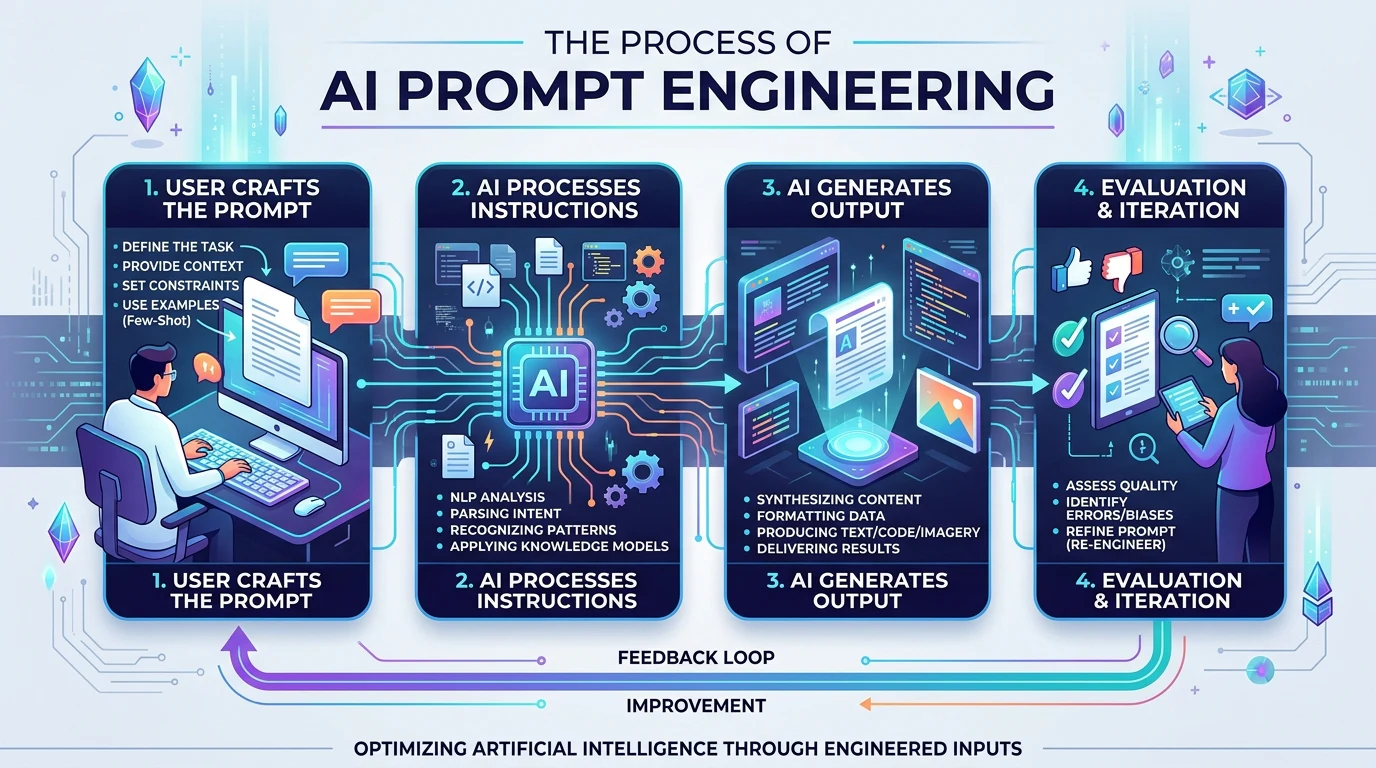
AI prompt engineering is the practice of designing, testing, and refining the instructions you give an AI model so it consistently produces accurate and useful output. In simple terms, AI prompt engineering is the skill of communicating with AI systems in a structured way to achieve better results.
It sounds simple — “just type a question into ChatGPT” — but there is a significant difference between a vague one-line prompt and a carefully structured prompt that includes context, format, tone, constraints, and examples. That difference in output quality is exactly why businesses are willing to pay for AI prompt writing and hire skilled AI prompt engineers.
How It Works
Good prompt engineering typically involves:
- Context setting — telling the AI who it should act as and what background information matters.
- Clear task definition — specifying exactly what output you want instead of asking for a general response.
- Format and constraints — defining the length, structure, tone, and what the AI should avoid.
- Examples (few-shot prompting) — showing the AI examples of the desired output.
- Iteration and testing — refining prompts based on real results and continuous experimentation.
Types of Prompt Engineering
- Conversational prompting — creating prompts for tools like ChatGPT or Claude for writing, research, and coding assistance.
- Image and video prompting — writing detailed prompts for Midjourney and AI video generators to create specific visual styles.
- System and product prompting — designing prompts that power AI features inside applications and business workflows.
- Evaluation and testing — building frameworks to measure whether prompts perform reliably across different scenarios.
For anyone interested in prompt engineering for beginners, understanding these fundamentals is the first step toward building a profitable prompt engineering business and learning how to make money with AI prompt engineering in 2026.
Types of Prompt Engineering
A Simple Example of What Separates a Weak Prompt from a Strong One
A weak prompt might say: “Write a product description for my candle business.”
A strong prompt specifies the audience, tone, format, length, and what to avoid: it names the target customer, the brand voice, the key selling points to emphasize, a word count range, and a specific structure (headline, three benefit bullets, closing line). The difference in output quality between those two prompts is enormous — and that gap in quality is precisely what buyers, clients, and employers are paying someone to close.
This is also why prompt engineering resists full automation by AI itself. Knowing what makes a prompt weak versus strong requires understanding the end goal, the audience, and the specific failure modes of the model you’re using — judgment that comes from testing and experience, not just familiarity with a chat interface.
Why Prompt Engineering Is a Huge Opportunity in 2026

The AI Market Is Still Expanding Rapidly
Industry projections put the global AI market on a path to exceed $1.3 trillion by 2030, with some longer-range estimates putting it closer to $2.4 trillion by 2032. Gartner has projected that more than 80% of enterprises will have integrated generative AI into their operations by 2026 — a huge base of companies that all need someone who can make their AI tools actually work well.
Businesses Have AI Access But Not AI Skill
Nearly every company now has access to ChatGPT, Claude, Gemini, or similar tools. Very few have anyone on staff who knows how to consistently get reliable, high-quality output from them. That gap between access and skill is exactly where prompt engineering income opportunities live, whether you’re freelancing, consulting, or selling prompt products directly.
Demand Has Shifted, Not Shrunk
AI-related skill requirements reached roughly 71% of US tech job postings in April 2026, up 181% year over year, and job-posting mentions tied to prompt engineering specifically have grown over 250% across a similar window. The demand for the underlying skill is unambiguous — what’s changed is which job titles ask for it.
Why Companies Hire for Prompt Skills Specifically
Companies pay for prompt engineering skill because a well-designed prompt system directly affects output quality, cost (shorter, more efficient prompts reduce token usage), and reliability at scale. A poorly prompted AI feature embarrassing a company publicly is a real, recurring risk — which is exactly why businesses will pay to get it right.
Pro Tip: Position yourself around outcomes, not the word “prompt.” Businesses don’t wake up wanting to buy “prompt engineering” — they want faster content production, more reliable AI customer support, or fewer embarrassing AI mistakes. Frame your services around the outcome, and the prompt work becomes the mechanism, not the pitch.
The Cost of Getting Prompts Wrong Is Rising, Not Falling
As more companies push AI tools into customer-facing roles — support chatbots, sales assistants, content generation at scale — the cost of a poorly designed prompt has gone up, not down. A single embarrassing or inaccurate AI output can spread widely and damage a brand’s reputation in a way that a private internal mistake never would have. That rising stakes environment is a big part of why businesses are increasingly willing to pay for tested, reliable prompt systems rather than relying on whatever an employee types on the fly.
Is Prompt Engineering Still Worth It in 2026?
This is the single most important question to answer honestly before investing time here, so let’s address it directly.
Is It Saturated?
The narrow “Prompt Engineer” job title is genuinely contracting — some job-board trackers report roughly a 30% decline in standalone listings using that exact title between 2024 and 2026. If you’re specifically hunting for a job titled “Prompt Engineer,” the market has tightened.
But the underlying skill has been absorbed into a wider set of roles: AI Engineer, Applied ML Engineer, LLM Engineer, AI Solutions Architect, and countless roles in marketing, product, and operations that now list prompt design as a required competency. Demand for the skill itself, regardless of title, has grown several times over the same period.
Reality Check: If prompt engineering were genuinely dying as a skill, you’d expect salaries to fall as the novelty wore off and supply caught up with demand. Instead, compensation data shows salary bands moving up, not down, year over year — a signal that’s hard to fake if the underlying skill weren’t still valuable.
Future Demand
As AI models get better at understanding plain-language input, basic one-line prompting is becoming closer to general digital literacy — something most professionals are expected to do adequately on their own. The higher-value, better-paid work is shifting toward prompt system design, evaluation frameworks, and domain-specific expertise layered on top of prompting.
Competition
Competition is real but uneven. Generic, surface-level prompt writing is genuinely crowded and low-value. Specialized prompt work — in a specific industry, paired with evaluation and testing skill, or bundled into a broader AI implementation service — faces far less competition and commands meaningfully higher rates.
Think of it in three tiers. At the bottom, anyone can type a request into ChatGPT — that tier is saturated and increasingly commoditized. In the middle, structured, tested prompts for a specific recurring task still have real value, but competition is growing. At the top, prompt systems paired with evaluation frameworks, domain expertise, and proven business outcomes remain genuinely scarce — and that’s where the durable income is.
Best Ways to Make Money with AI Prompt Engineering

Here are ten proven methods, ranging from beginner-friendly to more advanced.
1. Freelancing
Offering prompt engineering as a freelance service on platforms like Upwork, Fiverr, or Contra. AI and machine learning services command some of the higher hourly rates on major freelance platforms, with prompt engineering specifically often priced $15–$30 above the platform average. Freelancers on platforms like Upwork and Toptal report charging $80–$150 per hour for this work. The fastest way to land your first few clients is offering a narrow, clearly defined service — “custom email prompt system for your sales team” converts far better than a vague “AI help” listing.
Freelancing is one of the fastest ways to start earning. You can also read our complete guide to AI Freelancing in 2026
2. Selling Prompt Packs
Packaging tested, high-performing prompts into bundles and selling them on marketplaces like PromptBase, Gumroad, or Etsy. This is one of the lowest-barrier entry points — you need no client relationships, just a product people want to buy repeatedly. PromptBase in particular offers an 80% revenue share to sellers with zero listing fees, making it one of the more generous digital product marketplaces available. Successful packs tend to solve a specific, recurring problem for a specific audience rather than offering generic, one-size-fits-all prompts.
Prompt engineering can become a profitable side hustle alongside other opportunities covered in our guide to Best AI Side Hustles in 2026
3. Creating Courses
Teaching others how to write effective prompts is another excellent way to make money with AI prompt engineering. You can create a standalone course or bundle it with a prompt library and sell it through platforms like Gumroad, Teachable, or your own website. This strategy works best once you have established credibility through client results, a loyal audience, or a proven track record of selling AI prompt templates. In most cases, buyers are paying for your real-world experience and proven systems rather than information they could find for free.
4. Consulting
Consulting is one of the highest-paying opportunities in the AI prompt engineering business. Companies often hire a freelance prompt engineer to build custom prompt systems that improve productivity, automate workflows, or enhance AI-powered products.
Custom prompt engineering projects typically range from $200 to $1,500, while larger implementations can exceed $3,500 per project. A great way to attract clients is by offering a short “AI productivity audit” where you identify areas that could benefit from better prompts and then propose a customized solution.
This approach is especially attractive for businesses because effective prompt systems can save hundreds of work hours and significantly improve AI output quality.
5. Prompt Libraries
Building and maintaining a large, organized collection of prompts for a specific audience—such as marketers, real estate agents, or coaches—is another proven way to make money with prompt engineering.
A high-quality prompt library can be sold as a one-time product or as a recurring subscription. This method rewards organization, testing, and niche expertise more than any single prompt’s creativity. Buyers are not paying for a few prompts; they are paying for a complete, ready-to-use system that helps them achieve better results with AI.
For many entrepreneurs, selling prompt libraries eventually becomes the foundation of a scalable prompt engineering business that generates recurring income with minimal ongoing work.
6. Building AI Products
Building AI products is one of the most scalable ways to make money with AI prompt engineering. Instead of selling your time, you use your prompt engineering skills as the foundation of an AI-powered tool or micro-SaaS product. In this model, prompts become the “brain” of the application while users interact through a simple interface.
Although this path is more technical and may require some familiarity with no-code tools, it offers one of the highest income ceilings because you’re creating a recurring-revenue asset. Many successful founders have turned a simple prompt engineering business into profitable AI software products that generate income every month.
7. Agency Services
Another proven strategy is turning your freelance work into an agency that provides AI content creation or workflow automation services for businesses.
Most agencies charge monthly retainers ranging from $500 to $2,000 per client, depending on the complexity of the service. This path usually starts as a freelance prompt engineer business and gradually evolves into a team-based operation once demand exceeds what one person can handle.
For entrepreneurs looking to build a long-term AI side hustle, agency services can become a highly profitable and scalable business model.
8. Content Creation
Content creation is an excellent way to make money with prompt engineering while simultaneously building authority in the AI industry.
You can create a blog, YouTube channel, or newsletter that teaches prompt engineering techniques, reviews AI tools, and shares practical tutorials. Once your audience grows, you can monetize through affiliate partnerships, sponsorships, digital products, and premium prompt libraries.
For additional inspiration, check out our guide on AI Content Creation: 10 Proven Ways to Make Money in 2026, which covers more opportunities for creators using artificial intelligence.
9. Affiliate Marketing
Affiliate marketing is one of the easiest ways to generate passive income with AI prompt engineering. By recommending AI tools and platforms that you genuinely use, you can earn commissions whenever someone signs up through your referral links.
This strategy works particularly well if you already have a blog, newsletter, or YouTube audience interested in AI prompt writing, productivity, and artificial intelligence tools. Many AI companies offer recurring commissions, making affiliate marketing a powerful addition to any prompt engineering business.
10. Corporate Training
Delivering workshops or training sessions to help internal teams at companies improve how they use AI tools — a higher-ticket service that leverages both your prompting skill and your ability to teach it clearly to non-technical staff.
Beginner Tip: Don’t try all ten at once. Most successful prompt entrepreneurs start with one — usually selling prompt packs or freelancing — and only add consulting or courses once they have real results and testimonials to point to.
For a broader look at freelance income strategies beyond prompt engineering specifically, our guide to AI freelancing in 2026 covers additional service ideas and platform strategies.
Best Niches for Prompt Engineers
Specializing in a specific industry dramatically increases both your rates and your ability to stand out from generic prompt sellers.
| Niche | Why It’s Profitable |
|---|---|
| Marketing | High volume of repetitive content needs (ads, emails, social copy) that benefit enormously from reliable prompt systems |
| Education | Teachers and course creators need lesson plans, quizzes, and explanations tailored to specific reading levels |
| E-commerce | Product descriptions, ad copy, and customer service responses at scale reward well-tested prompt templates |
| Healthcare | High-stakes accuracy requirements mean businesses pay well for reliable, carefully tested prompt systems, though this niche demands extra care with accuracy and compliance |
| Programming | Developers pay for prompts that reliably generate clean, well-structured code and documentation |
| Finance | Compliance-sensitive content and analysis needs create demand for prompts with built-in accuracy safeguards |
| Productivity | A broad, engaged buyer base looking for prompts that streamline daily work tasks and planning |
Pro Tip: Healthcare startups deploying AI assistants don’t just need well-written prompts — they need audit trails, safe retrieval practices, and terminology accuracy. That kind of sector-specific depth is exactly what separates a $50 generic prompt pack from a $2,000 custom consulting engagement.
Best AI Tools for Prompt Engineering in 2026

Fluency across multiple models — not just one — is increasingly valuable, since different tools have different strengths for different prompting tasks.
| Tool | Best For | Free Plan? | Pricing |
|---|---|---|---|
| ChatGPT | General-purpose prompting, broad audience familiarity | Yes | Free; Plus from ~$20/month |
| Claude | Long-form, structured, and nuanced prompting tasks | Yes | Free; paid plans from ~$20/month |
| Gemini | Prompting tied to Google Workspace integrations | Yes | Free; paid plans from ~$20/month |
| Perplexity | Research-oriented prompting with source citations | Yes | Free; Pro from ~$20/month |
| Grok | Real-time and conversational prompting on X | Yes (with X account) | Included with X Premium tiers |
| Poe | Testing prompts across multiple models in one place | Yes | Free; paid plans from ~$20/month |
| NotebookLM | Prompting against your own uploaded documents and sources | Yes | Free; expanded limits on paid tiers |
| Cursor | Prompt engineering for code generation and developer workflows | Yes (limited) | Paid plans from ~$20/month |
How to choose: Learn one conversational model deeply (ChatGPT or Claude) before branching out. Buyers and clients care whether your prompts actually work reliably — not how many tools you’ve tried.
Testing the same prompt across two or three different models is also a valuable habit to build early, since techniques that work well on one model don’t always transfer cleanly to another. A prompt structure that reliably produces great output from Claude might need adjustment to get equally strong results from Gemini or Grok — understanding those differences is itself part of what makes an experienced prompt engineer more valuable than someone who has only ever used one tool.
Beginner Tip: Keep a simple running document of prompts that worked well, what you changed to improve them, and which model you tested them on. This becomes both your personal prompt library and the raw material for your first sellable prompt pack.
For a deeper breakdown of AI tools beyond prompt engineering specifically, our guide to the best AI tools for beginners in 2026 covers additional categories and comparisons.
How Much Money Can Prompt Engineers Make?

Income varies enormously depending on whether you’re pursuing employment, freelancing, or building a product business. Here’s a realistic breakdown across all three paths.
Full-Time Employment Income
| Experience Level | Typical Annual Salary |
|---|---|
| Entry-level | $90,000–$125,000 |
| Mid-level | $130,000–$175,000 |
| Senior-level | $150,000–$250,000+ |
| Frontier AI labs (specialized roles) | $500,000–$1.2M total compensation |
Salary aggregators show a fairly wide range depending on the source and how narrowly “prompt engineer” is defined — Glassdoor reports an average salary around $131,483, with top earners reaching roughly $208,983, while broader data compiled by prompt engineering communities puts the median base salary closer to $145,000 in 2026. The consistent pattern across sources: compensation has risen, not fallen, year over year.
Freelance and Side Hustle Income
| Path | Beginner | Intermediate | Advanced |
|---|---|---|---|
| Freelance hourly work | $500–$1,500/month (part-time) | $1,500–$5,000/month | $5,000–$15,000+/month |
| Selling prompt packs | $50–$200/month | $500–$2,000/month | $2,000–$15,000+/month |
| Consulting/custom projects | $200–$500/project | $500–$1,500/project | $1,500–$5,000+/project |
A realistic first-year target for a committed side hustler combining these methods is roughly $500–$3,000 in monthly revenue, depending on hours invested and how quickly you build a reputation.
Real examples illustrate the range well: one prompt seller earned $91.77 from a single $4.99 prompt selling 23 times in its first week, then grew to $847 across 60 days of consistent listing. Another creator’s Gumroad prompt pack business grew from $810 in month one to $2,400 by month two, then added a $3,500 consulting project, reaching roughly $8,700 in combined monthly income by month six. On PromptBase specifically, established sellers with extensive catalogs report $500–$2,000 monthly, while new sellers with 10–20 listings typically earn $50–$200 in their first few months while building reviews.
Reality Check: These income examples represent people who stayed consistent for months, not overnight results. A new PromptBase seller with a handful of listings should expect a slow first few months — the sellers earning $2,000+ monthly built large, tested catalogs over time, not in their first week.
A Realistic Growth Timeline
Real-world examples show that it is entirely possible to make money with AI prompt engineering, but success usually comes from consistency rather than overnight results.
One documented case involved a former marketing manager who began systematically cataloging effective prompts for email marketing, social media, and blog content while improving her own workflows. After building a library of more than 200 prompts and listing them on PromptBase, she was generating approximately $800 per month in passive income within six months. It’s a realistic example of how a small prompt engineering business can gradually turn into a reliable income stream.
Another creator combined prompt pack sales with consulting services. Starting with a single $27 prompt pack that sold 30 copies in its first month, the creator later launched two additional products and secured a $3,500 custom consulting project by month three. By month six, the business was generating roughly $8,700 per month while requiring only about 15 hours of work each week.
The lesson from both examples is clear: people who make money with prompt engineering usually focus on building valuable assets, expanding their product catalog, and maintaining consistent visibility over time instead of chasing quick wins.
How Long Does It Take to Make Your First $1,000?
| Method | Estimated Time |
|---|---|
| Freelance client work | 1–3 months |
| Selling prompt packs (marketplace) | 3–6 months |
| Consulting projects | 1–3 months (once you land your first client) |
| Course or digital product sales | 2–6 months |
Freelancing and consulting tend to produce your first $1,000 fastest because you’re paid directly for delivered work rather than waiting on marketplace discovery. Prompt pack sales typically take longer to compound, since building enough catalog depth and marketplace visibility to generate consistent sales takes sustained, patient effort — but they pay off with less ongoing time investment once established.
Step-by-Step Plan to Start a Prompt Engineering Business
Week 1: Learn and Choose Your Path
- Spend focused time practicing prompt writing across ChatGPT and Claude, testing the same task multiple ways to see what actually improves output quality.
- Choose your primary path from the ten methods above based on your interests, existing skills, and available time.
- Study 3–5 successful prompt sellers or freelancers in your chosen niche to understand pricing and positioning.
Week 2: Build Your First Product or Portfolio
- If selling prompts: build your first pack of 15–20 tested prompts, fully documented with example outputs.
- If freelancing: create 2–3 sample projects demonstrating your prompting skill for a specific use case or industry.
- Design clean presentation materials in Canva showing prompts alongside their example outputs.
Week 3: Launch and List
- List your prompt pack on Gumroad, Etsy, and PromptBase simultaneously — you can’t predict which channel converts best without testing.
- If freelancing, set up profiles on Upwork, Fiverr, or Contra with a clear, specific service description.
- Begin sharing prompt tips and before/after examples on LinkedIn or X to build visibility.
Week 4: Reach Out and Refine
- Send personalized outreach to 15–20 potential clients or connections relevant to your chosen niche.
- Review early sales or client response data and adjust your pricing, positioning, or product based on what you’re learning.
- Set a specific, realistic income goal for month two based on your first month’s results.
30-Day Checklist:
- [ ] Comfortable writing and testing prompts across at least one major AI model
- [ ] Chosen one primary monetization method rather than spreading across all ten
- [ ] Built and documented your first prompt pack or portfolio sample
- [ ] Listed your product or profile on at least two platforms
- [ ] Reached out to at least 15 potential clients, connections, or communities in your niche
For a broader view of AI income strategies beyond prompt engineering, our guides on how to make money with AI in 2026 and best AI side hustles in 2026 cover additional paths worth exploring alongside this one.
Common Beginner Mistakes
1. Selling Generic, One-Line Prompts
A prompt like “Write a marketing email” is not a sellable product. Buyers pay for detailed, tested prompts that solve specific problems. If anyone can write the same prompt in ten seconds, it has little market value and won’t help you make money with AI prompt engineering.
2. Chasing the “Prompt Engineer” Job Title Only
Many beginners focus only on finding jobs with the exact title “Prompt Engineer.” In reality, prompt engineering skills are now embedded in roles like AI Engineer, AI Consultant, and AI Solutions Architect. Expanding your search can uncover many more AI career opportunities.
3. Not Including Example Outputs
Whether you’re selling prompt packs or offering freelance services, buyers want proof that your prompts work. Including sample outputs builds trust and significantly improves conversion rates.
4. Listing on Only One Marketplace
If you’re selling prompts, don’t rely on a single platform. Listing your products on PromptBase, Gumroad, and Etsy increases visibility and helps you reach different audiences without creating additional work.
5. Overpricing Without Proof of Quality
Many beginners charge premium prices before building credibility. Focus on collecting reviews, testimonials, and case studies first. A strong reputation is often more valuable than maximizing your profit margins early on.
6. Ignoring Evaluation and Testing Skills
One of the most important skills in AI prompt engineering is proving that a prompt works consistently across multiple scenarios. Businesses value reliable systems far more than one-time successes.
7. Treating It as Passive Income From Day One
A successful prompt engineering business still requires maintenance. Prompt libraries and digital products need updates as AI models evolve and customer needs change.
8. Skipping Niche Specialization
Generic prompt sellers face heavy competition. Specializing in industries like healthcare, finance, or marketing can help you stand out and command significantly higher prices.
9. Underestimating Consulting and Freelance Pricing
Many new freelancers charge far less than businesses are willing to pay. If your prompt system saves a company time or increases productivity, your service has real business value.
10. Not Updating Prompts as AI Models Change
AI tools are evolving rapidly. A prompt that works perfectly today may produce weaker results after a model update. Ongoing testing and refinement are essential for anyone serious about building a long-term prompt engineering business.
Beginner Tip: If you’re new to prompt engineering for beginners, focus on building a small portfolio, testing your prompts regularly, and specializing in one niche before trying to scale your business. These simple steps can dramatically increase your chances of making money with AI prompt engineering in 2026.
Future of Prompt Engineering (2026–2027)
- The standalone job title will keep shrinking while the skill keeps spreading. Expect prompt engineering to continue merging into broader AI engineering, product, and operations roles rather than existing as an isolated specialty — recruiters are already retitling a majority of “prompt engineer” requisitions into broader AI engineering searches because they fill faster.
- Evaluation and testing skills will become as valuable as prompt writing itself. Hiring managers increasingly emphasize the ability to prove a prompt works reliably in production, not just in a single demo, which means beginners who invest in learning basic evaluation frameworks now will have a real edge later.
- Basic prompting will become a baseline professional skill. As models improve at understanding plain-language requests, simple one-off prompting will look more like general digital literacy than a specialized service — closer to knowing how to use a spreadsheet than a distinct career path.
- Domain expertise paired with prompting will command premium value. The winners going forward pair prompt skill with product, engineering, security, or specific industry knowledge rather than competing on prompting alone, since raw prompting skill alone is becoming harder to differentiate.
- Prompt marketplaces will keep maturing. Expect more structured categories, quality verification, and possibly subscription-based prompt libraries as the marketplace model matures beyond one-off purchases, similar to how other digital product marketplaces have evolved over time.
- Workflow and systems design will separate senior from junior prompt work. The ability to design how humans, AI, and existing software fit together — deciding what the AI should own and what still needs a human check — is increasingly the differentiator between someone who can demo a prompt and someone who can ship one that works reliably at scale.
Frequently Asked Questions
How to make money with AI prompt engineering as a complete beginner?
Start by practicing prompt writing daily across ChatGPT and Claude, then choose one monetization method. Selling prompt packs or freelancing are among the easiest ways to make money with AI prompt engineering as a beginner. Build a small portfolio before pursuing clients or marketplace sales.
How much do prompt engineers make?
Full-time AI prompt engineering salaries typically range from $90,000 to $250,000 depending on experience level, while freelance and side-hustle income ranges from $500 to $15,000+ per month based on experience, niche, and consistency.
Is prompt engineering still worth it in 2026?
Yes. Although the standalone “Prompt Engineer” title has become less common, demand for AI prompt engineering skills continues to grow across technology, marketing, finance, and healthcare industries.
How do I become an AI prompt engineer with no experience?
The best approach to prompt engineering for beginners is to practice writing prompts across multiple AI tools, document your results, build a small portfolio, and start freelancing or selling prompts on marketplaces like PromptBase.
Can you really make money selling AI prompts?
Yes. Many creators make money with prompt engineering by selling prompt packs, building prompt libraries, and offering consulting services to businesses.
Is prompt engineering a good side hustle?
Yes. AI prompt engineering is one of the most accessible AI side hustles because startup costs are low and the skills can be learned gradually while working a full-time job.
Can prompt engineering become a full-time income?
Absolutely. Many entrepreneurs combine freelancing, consulting, and digital products to make money with AI prompt engineering and eventually turn it into a full-time business.
How is prompt engineering different from AI content creation?
Prompt engineering focuses on designing and testing instructions that produce reliable AI outputs, while AI content creation focuses on producing finished articles, videos, images, and other content assets using those prompts.
Key Takeaways
- How to make money with AI prompt engineering is still a viable opportunity in 2026, even though the standalone “Prompt Engineer” job title has become less common. The underlying skill demand has grown significantly across multiple industries.
- Income potential varies widely, ranging from $90,000–$250,000+ annually for full-time roles and $500–$15,000+ per month for freelance and product-based businesses.
- Selling prompt packs, freelancing, and consulting remain the most beginner-friendly ways to make money with prompt engineering, with startup costs often below $50 per month.
- Specializing in a niche and developing strong evaluation and testing skills can significantly increase your earning potential and help you stand out in the growing AI prompt engineering market.
- Most successful examples of prompt engineering businesses took three to six months of consistent work before generating meaningful income, proving that long-term consistency matters more than quick wins.
Conclusion
AI prompt engineering in 2026 is no longer the hype-driven gold rush it appeared to be in 2023, and that’s actually good news for people approaching it as a real business opportunity. The skill has become deeply integrated into freelancing, consulting, product development, and broader AI careers.
If your goal is to make money with AI prompt engineering, start with a single method from this guide. Selling your first prompt pack, landing a freelance client, or building a niche prompt library can provide the proof of concept you need to grow further.
The most successful people in this industry didn’t achieve results overnight. They spent months testing prompts, improving their skills, and building valuable assets. With consistent effort, AI prompt engineering can become a profitable side hustle, a freelance business, or even a full-time income stream.
Ready to expand your AI income opportunities? Explore our related guides:
- How to Make Money with AI in 2026
- Best AI Side Hustles in 2026
- AI Freelancing in 2026
- AI Content Creation: 10 Proven Ways to Make Money in 2026
These resources will help you build a complete strategy for making money with artificial intelligence beyond prompt engineering alone.