

Best AI Freelancing Guide for Beginners in 2026: Earn Money with AI
AI freelancing has quietly become one of the fastest-growing ways to earn money online in 2026. What used to require a specialized skill set — writing, design, video editing, coding — can now be delivered faster and more affordably thanks to AI tools, opening the door for beginners to offer real, paid services without years of training.
If you’ve ever thought about freelancing but felt like you didn’t have “a skill” to sell, this guide is for you. AI freelancing lowers that barrier significantly. You don’t need to be a professional writer, designer, or developer. You need to know how to direct AI tools effectively, deliver quality work, and communicate well with clients.
This guide walks through everything a complete beginner needs: what AI freelancing actually is, the best services to offer, the tools to use, where to find clients, realistic income expectations, and a step-by-step plan to get your first paying client.
What Is AI Freelancing?

AI freelancing means offering freelance services where artificial intelligence tools handle a significant part of the production work, while you provide direction, quality control, and the client relationship.
Instead of writing every article from scratch, designing every graphic by hand, or editing every video frame by frame, an AI freelancer uses tools like ChatGPT, Claude, Midjourney, or CapCut to produce a strong first draft — then refines it into something client-ready.
This isn’t about pretending AI does everything for you. Clients are paying for outcomes: a well-written article, a polished logo, a working chatbot. How you get there — faster, thanks to AI — is your competitive advantage, not something to hide.
The core skills of AI freelancing include:
- Prompt writing — giving AI tools clear, specific instructions to get usable output
- Editing and quality control — refining AI output into something professional and accurate
- Client communication — understanding what a client actually needs and delivering it well
- Tool fluency — knowing which AI tool fits which task, and how to use it efficiently
If you can learn these four things, you have what it takes to become an AI freelancer — regardless of your background.
Why AI Freelancing Is Growing So Fast
Several forces are converging to make 2026 one of the best times to start freelancing with AI.
AI Adoption Has Reached the Mainstream
AI tools have moved from “interesting experiment” to “daily business tool” for millions of companies and solo entrepreneurs. As more businesses adopt AI internally, they also look for freelancers who already know how to use these tools well, rather than starting from scratch themselves.
Remote Work Is Permanent
Remote work is no longer a pandemic-era exception — it’s simply how a huge portion of the workforce now operates. This has normalized hiring freelancers from anywhere in the world, which benefits AI freelancers who can serve clients regardless of location or time zone.
Small Businesses Need Help, But Can’t Afford Agencies
Small business owners increasingly recognize the value of AI-powered content, design, and automation, but most don’t have the time or expertise to implement it themselves. That gap creates steady freelance demand — small businesses would rather pay a freelancer a few hundred dollars than hire a full agency.
Startup Costs Have Collapsed
Traditional freelance careers in writing, design, or video editing often required years of skill-building and expensive software. AI freelancing dramatically lowers both the time and cost investment — many tools offer free tiers, and you can start delivering client work within days, not years.
The Opportunity Is Global
Because most AI freelance work is delivered entirely online, freelancers anywhere in the world can serve clients anywhere else. A freelancer in Cairo can serve a client in Chicago just as easily as one across town — geography no longer limits opportunity the way it once did.
Best AI Freelance Services to Offer
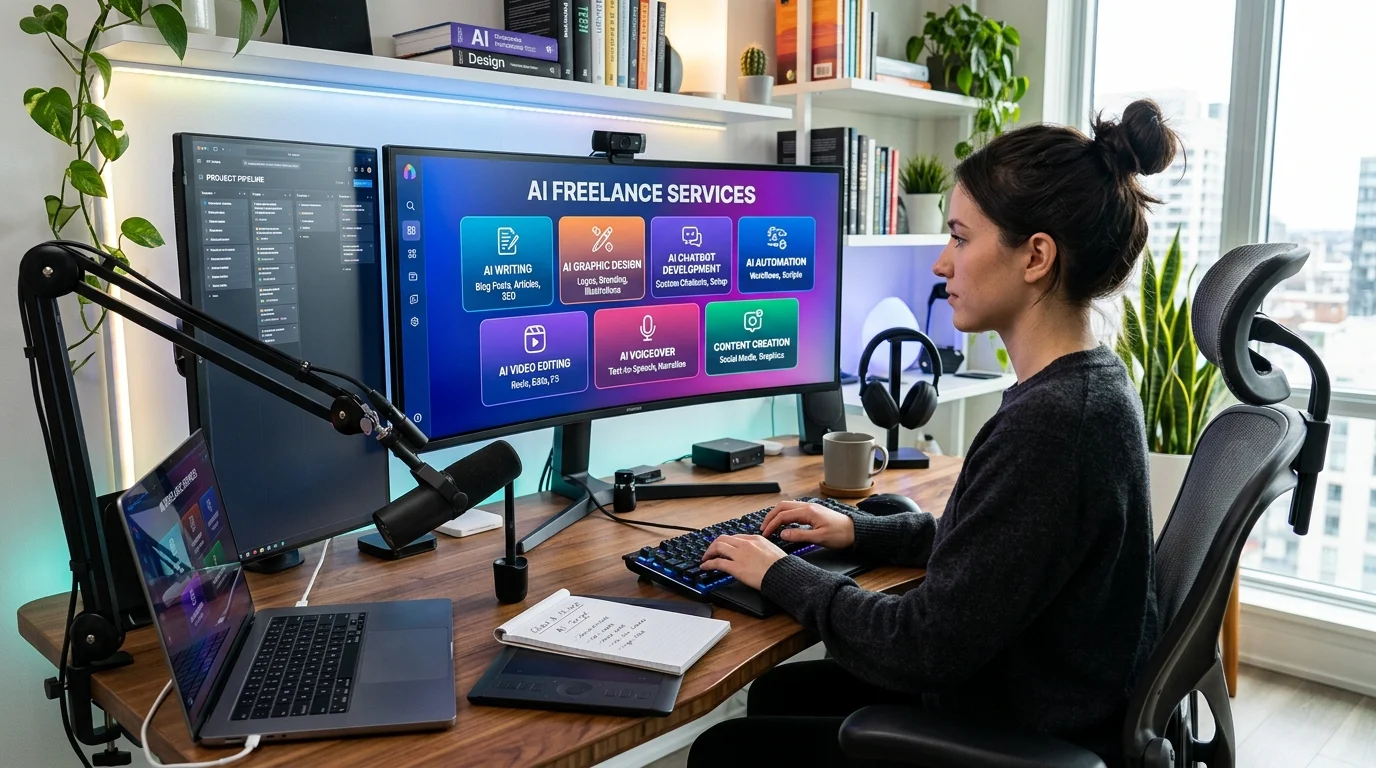
Here are ten of the most in-demand AI freelance services you can start offering right now.
1. AI Content Writing
What it is: Writing blog posts, articles, product descriptions, and web copy using AI to draft, then editing for accuracy, tone, and originality.
Skills needed: Basic writing and editing ability, understanding of SEO fundamentals.
Recommended AI tools: Claude, ChatGPT, Grammarly.
Income potential: $20–$150 per article; $300–$2,000/month for retainer clients.
Difficulty: Beginner.
Beginner tips: Never submit raw AI output — always edit for voice, accuracy, and originality. Specialize in one niche (finance, health, SaaS) to stand out from generalist writers.
2. AI Copywriting
What it is: Writing persuasive marketing copy — ads, email sequences, landing pages, and sales pages — using AI to generate options, then refining based on conversion best practices.
Skills needed: Understanding of persuasive writing and basic marketing psychology.
Recommended AI tools: ChatGPT, Claude, Jasper.
Income potential: $50–$300 per project; $500–$3,000/month for ongoing email or ad copy clients.
Difficulty: Beginner to Intermediate.
Beginner tips: Study a few classic copywriting frameworks (AIDA, PAS) so you can guide AI output toward proven structures instead of generic phrasing.
3. AI Graphic Design
What it is: Creating logos, social media graphics, and marketing visuals using AI image generators, refined with design software for a polished final product.
Skills needed: Basic design sense, prompt writing, familiarity with Canva or similar tools.
Recommended AI tools: Midjourney, Adobe Firefly, Canva AI.
Income potential: $20–$200 per design; $500–$3,000/month for consistent clients.
Difficulty: Beginner to Intermediate.
Beginner tips: Build a portfolio that shows your process — raw AI output next to your refined final version — to demonstrate the value you add beyond the tool itself.
4. AI Video Editing
What it is: Editing and enhancing video content using AI-powered tools for captions, background removal, and pacing adjustments.
Skills needed: Basic video editing knowledge, understanding of storytelling and pacing.
Recommended AI tools: CapCut, Descript, Runway.
Income potential: $30–$150 per video; $500–$3,000/month for regular clients.
Difficulty: Intermediate.
Beginner tips: Specialize in one content format — podcasts, YouTube videos, or short-form social clips — rather than trying to serve every video type at once.
5. AI Voiceover Services
What it is: Producing AI-generated voiceovers for videos, ads, e-learning content, and audiobooks.
Skills needed: Basic audio editing, sense of tone and pacing.
Recommended AI tools: ElevenLabs, Murf, Descript.
Income potential: $30–$200 per project; $300–$2,000/month for regular clients.
Difficulty: Beginner to Intermediate.
Beginner tips: Create a demo reel with a few different tones (professional, casual, energetic) so potential clients can quickly hear your range.
6. AI Chatbot Setup
What it is: Building and installing AI-powered chatbots on business websites to handle FAQs, lead capture, and basic customer support.
Skills needed: Basic understanding of chatbot platforms, clear client communication.
Recommended AI tools: ChatGPT (via API), Voiceflow, Tidio.
Income potential: $150–$1,000 per setup; $30–$150/month in ongoing maintenance.
Difficulty: Intermediate.
Beginner tips: Build one reusable chatbot template that you can customize quickly for each new client instead of starting from scratch every time.
7. AI Automation
What it is: Helping businesses automate repetitive tasks — lead follow-ups, appointment scheduling, data entry — using no-code automation platforms combined with AI.
Skills needed: Problem-solving mindset, basic familiarity with automation logic.
Recommended AI tools: Zapier, Make.com, n8n.
Income potential: $200–$1,500 per project; $50–$300/month in maintenance retainers.
Difficulty: Intermediate.
Beginner tips: Start with one simple, high-value automation — like lead follow-up — and use it as your flagship offer before expanding into more complex workflows.
8. AI Prompt Engineering
What it is: Creating and selling tested, high-performing prompts that help clients or marketplace buyers get better, more consistent results from AI tools.
Skills needed: Deep familiarity with a specific AI tool, testing and documentation skills.
Recommended AI tools: Midjourney, ChatGPT, Claude.
Income potential: $5–$50 per prompt pack; $100–$1,000+/month for popular libraries or consulting work.
Difficulty: Beginner to Intermediate.
Beginner tips: Focus on one specific use case, like product photography prompts or marketing copy prompts, rather than a generic mixed bag.
9. AI Social Media Management
What it is: Managing a business’s social media presence using AI tools to draft captions, generate graphics, and plan content calendars.
Skills needed: Understanding of social media trends, basic content planning, client communication.
Recommended AI tools: ChatGPT, Canva AI, Buffer or Later for scheduling.
Income potential: $300–$1,500/month per client retainer.
Difficulty: Beginner to Intermediate.
Beginner tips: Offer a clear monthly package (e.g., “12 posts + 4 stories per month”) so clients know exactly what they’re paying for.
10. AI Virtual Assistant Services
What it is: Providing administrative and operational support — email management, scheduling, research, data organization — using AI tools to work faster and more efficiently.
Skills needed: Organization, communication, basic familiarity with productivity tools.
Recommended AI tools: ChatGPT or Claude for drafting and research, Zapier for automating repetitive tasks.
Income potential: $15–$40/hour; $500–$2,500/month for part-time retainer clients.
Difficulty: Beginner.
Beginner tips: Highlight your AI-assisted efficiency as a selling point — clients love knowing tasks get done faster without sacrificing quality.
Best AI Tools for Freelancers

Choosing the right combination of tools matters more than trying to use everything at once. Here’s a breakdown of the most useful AI tools for freelancers in 2026.
| Tool | Best For | When to Use It |
|---|---|---|
| ChatGPT | Writing, brainstorming, coding help | General-purpose drafting, client research, quick problem-solving |
| Claude | Long-form writing, detailed analysis | In-depth articles, business documents, careful editing tasks |
| Gemini | Research, Google Workspace integration | Research-heavy projects, clients using Google tools |
| Canva AI | Design and formatting | Social graphics, presentations, quick branding assets |
| Midjourney | High-quality AI image generation | Illustrations, marketing visuals, artistic design work |
| ElevenLabs | AI voice generation | Voiceovers, narration, multilingual audio projects |
| CapCut | Video editing with AI features | Short-form video, social content, quick captions |
| Descript | Transcription-based video/audio editing | Podcasts, interview-style content, script-based editing |
| Zapier | No-code automation | Connecting apps, automating repetitive client workflows |
| Make.com | Advanced no-code automation | More complex, multi-step automation projects |
How to choose: Pick one core writing/thinking tool (ChatGPT or Claude), one tool specific to your service (Midjourney for design, CapCut for video, Zapier for automation), and master those two deeply before adding anything else to your stack.
For a deeper breakdown of tool options, our guide to the best AI tools for beginners in 2026 covers additional comparisons and use cases.
Where to Find AI Freelance Clients

Having the skills and tools is only half the equation — you also need a steady pipeline of clients. Here’s where AI freelancers are finding work in 2026.
Fiverr
Best for beginners because clients come to you with a specific need already in mind. Create clear, specific gig listings (e.g., “AI-Powered Blog Writing” rather than just “Content Writing”) to stand out.
Upwork
Better suited for larger projects and longer-term client relationships. Build a strong profile with a portfolio and take the time to write personalized proposals rather than generic templates.
Freelancer.com
A solid secondary platform, particularly useful for beginners casting a wider net across multiple freelance marketplaces at once.
Contra
A commission-free freelance platform that’s gained traction among creative and AI-savvy freelancers. Worth setting up alongside Fiverr and Upwork rather than as your only platform.
Extremely effective for B2B services like AI automation, chatbot setup, or copywriting. Post case studies and helpful content regularly to attract inbound interest from business owners and marketing teams.
X (Twitter)
A strong platform for building an audience around a specific AI skill. Sharing before/after examples, quick tips, and results builds credibility and often leads to inbound client inquiries.
Cold Outreach
Directly emailing or messaging small businesses that could benefit from your service — a chatbot, automated follow-ups, or better content — remains one of the most effective ways to land your first few clients, especially before you have a public portfolio.
Personal Website
A simple portfolio website, even a single page, adds credibility and gives you a professional place to direct potential clients from social media, cold outreach, or referrals.
How Much Can AI Freelancers Earn in 2026?
Income varies significantly based on your service, experience, and consistency. Here’s a realistic breakdown by experience level.
| Experience Level | Monthly Income Range | Typical Situation |
|---|---|---|
| Beginner (0–3 months) | $100–$800/month | Building portfolio, taking smaller gigs, learning client communication |
| Intermediate (3–12 months) | $800–$3,000/month | Repeat clients, refined service packages, growing reputation |
| Advanced (1+ years) | $3,000–$10,000+/month | Premium pricing, retainer clients, possibly hiring subcontractors |
These ranges reflect realistic outcomes for consistent, focused effort — not overnight success stories. Your actual income depends heavily on your chosen service, niche, and how consistently you market yourself.
Step-by-Step Plan to Start AI Freelancing
Here’s a practical 30-day roadmap to land your first AI freelancing client.
Week 1: Foundation
- Choose one AI freelance service from the list above based on your interests and existing skills.
- Sign up for the core AI tool(s) needed and spend several hours practicing until you’re comfortable.
- Study 3–5 successful freelancers offering the same service to understand pricing and positioning.
Week 2: Portfolio and Setup
- Create 2–3 sample projects to showcase your work, even if they’re for a fictional or practice client.
- Set up profiles on your chosen freelance platforms (start with one or two, not five).
- Write clear, specific service descriptions and set initial pricing based on your research.
Week 3: Outreach and Launch
- Submit your first gig applications or proposals on freelance platforms.
- Send cold outreach messages to 10–20 small businesses that could benefit from your service.
- Share your work on LinkedIn or X to start building visibility.
Week 4: Delivery and Refinement
- Complete your first paid project with extra attention to quality and communication.
- Request a testimonial or review from your first client.
- Review what worked and didn’t, then refine your pricing, positioning, or outreach approach for month two.
If you want a broader view of AI income opportunities beyond freelancing specifically, our guide on how to make money with AI in 2026 covers additional paths, and our roundup of the best AI side hustles in 2026 offers more ideas if freelancing isn’t the right fit for you.
Common Mistakes Beginners Make
- Expecting instant results. Most freelancers land their first client within weeks, not days — patience and consistency matter.
- Trying to offer every service at once. Spreading yourself across five different AI services usually means mastering none of them well.
- Submitting unedited AI output. Clients can tell when work hasn’t been refined — always add a human layer of quality control.
- Underpricing your services. Charging too little attracts the wrong clients and makes it harder to raise rates later.
- Overpricing without proof. Without a portfolio or testimonials, premium pricing can scare off your first potential clients.
- Ignoring niche specialization. Generalist freelancers often struggle to stand out; a specific niche builds authority faster.
- Skipping the portfolio. Even with no paid clients yet, sample projects demonstrate your capability and build trust.
- Being vague in gig descriptions. Clear, specific service descriptions convert better than generic listings.
- Neglecting client communication. Fast responses and clear expectations often matter as much as the quality of the work itself.
- Giving up too early. Many freelancers quit right before consistency starts paying off — the first month is usually the hardest.
- Not asking for testimonials. Skipping this step means missing out on powerful social proof that could help you land future clients.
- Failing to track what’s working. Without basic tracking of which platforms or outreach methods bring in clients, it’s hard to know where to focus your energy.
Future of AI Freelancing
The AI freelancing landscape will continue to shift over the next few years. Here’s what’s likely ahead.
- AI agents will handle more routine tasks. As AI agents become capable of completing multi-step tasks independently, freelancers who know how to configure and manage these agents for clients will be in high demand.
- Automation will become a standard offering. More freelancers will bundle automation setup into their existing services, since businesses increasingly expect efficiency gains alongside creative or technical work.
- Specialized AI services will grow. As the market matures, generic “AI content writer” positioning will give way to specialized niches — AI content for real estate, AI automation for healthcare clinics, and similar focused offerings.
- Personal branding will matter more. Freelancers who build a visible reputation through social media, case studies, and consistent content will have an edge over those relying solely on freelance marketplaces.
- Premium consulting opportunities will expand. As businesses seek deeper AI integration, experienced freelancers will increasingly move from one-off gigs into higher-value consulting relationships, helping companies build entire AI-powered workflows rather than single deliverables.
Freelancers who stay adaptable, keep learning new tools, and prioritize genuine client value will be best positioned to benefit as this space continues to evolve.
Frequently Asked Questions
What is AI freelancing? AI freelancing is offering freelance services — like writing, design, video editing, or automation — where AI tools handle a significant part of the production work, while you provide direction, quality control, and client communication.
How do I become an AI freelancer with no experience? Start by choosing one AI freelance service that matches your interests, practice with the relevant AI tools until you’re comfortable, build a small portfolio of sample work, and create profiles on freelance platforms like Fiverr or Upwork to find your first clients.
What are the best AI freelance services for beginners? AI content writing, AI resume and copywriting services, and AI virtual assistant work tend to be the easiest starting points, since they require minimal upfront investment and no advanced technical skills.
How much can AI freelancers earn in 2026? Beginner AI freelancers typically earn $100–$800 per month while building their portfolio, intermediate freelancers earn $800–$3,000 per month with repeat clients, and advanced freelancers can earn $3,000–$10,000 or more per month with premium pricing and retainer clients.
What are the best AI tools for freelancers? ChatGPT and Claude are strong choices for writing and strategy, Midjourney for image generation, ElevenLabs for voiceovers, CapCut and Descript for video editing, and Zapier or Make.com for automation work.
Where can I find AI freelance jobs? Popular platforms include Fiverr, Upwork, Freelancer.com, and Contra, along with LinkedIn and X for building visibility, and direct cold outreach to small businesses that could benefit from your services.
Is AI freelancing a legitimate way to make money online? Yes. AI freelancing is a legitimate, practical way to earn income by combining AI tools with real skills like editing, client communication, and quality control — it simply speeds up the production process rather than eliminating the need for genuine expertise.
Do I need to disclose that I use AI tools to clients? Being transparent about your AI-assisted process builds trust with clients and sets clear expectations, especially since the value you provide comes from your judgment, editing, and quality control on top of the AI-generated draft.
How long does it take to get your first AI freelancing client? With consistent effort — building a portfolio, setting up platform profiles, and reaching out to potential clients — many beginners land their first paid project within 30 days, following a structured plan like the roadmap outlined in this guide.
What’s the biggest mistake new AI freelancers make? Trying to offer too many services at once. Freelancers who choose one AI freelance service, build genuine skill in that area, and stay consistent with outreach tend to see much faster and more sustainable results than those spreading themselves too thin.
Conclusion
AI freelancing in 2026 offers a genuinely accessible path to online income, whether you’re a complete beginner, a student, or an experienced freelancer looking to add new services. The barrier to entry has never been lower, and the demand from businesses looking for AI-powered help has never been higher.
Start small. Choose one service, master a couple of AI tools, and commit to the 30-day plan outlined above. Your first paying client is closer than you think.
For more practical guidance on building income with AI, explore our complete guide on how to make money with AI in 2026 and our roundup of the best AI side hustles in 2026 to keep expanding your options as you grow your freelancing business.